
Pakistan Test-Fires Fa’az, Its First Homegrown Air-to-Air Missile, From a JF-17 Thunder

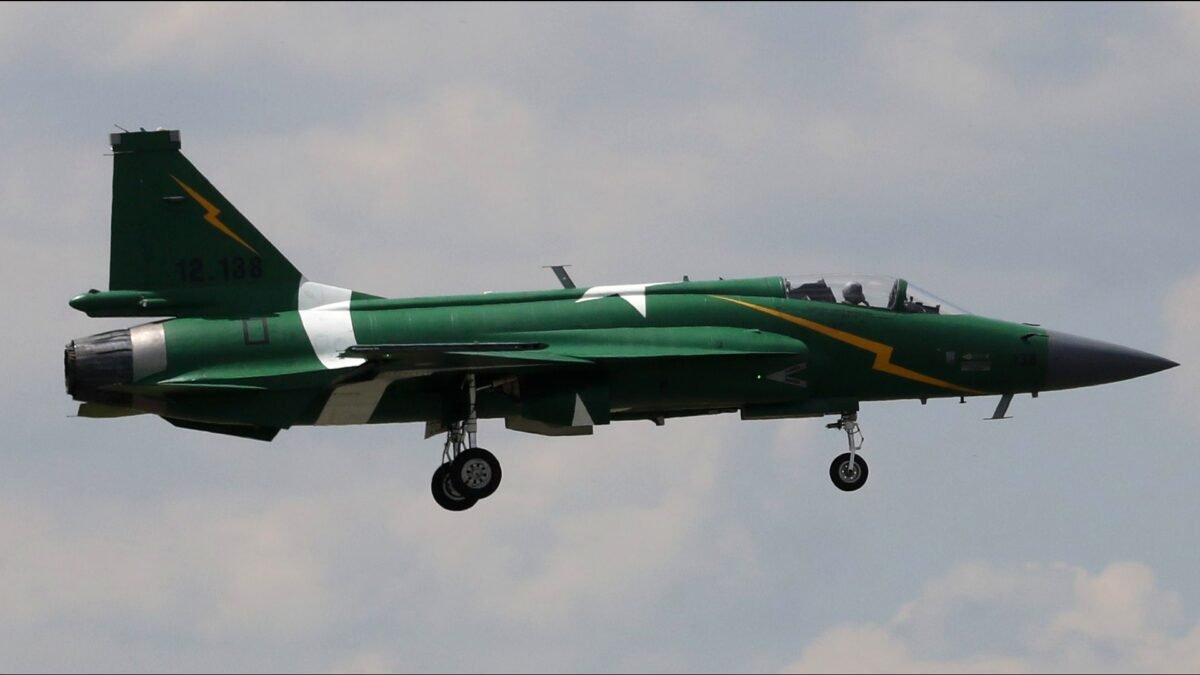
Pakistan has successfully flight-tested its first indigenously developed air-to-air missile, the Fa’az, the Pakistan Air Force announced on Tuesday, 3 November, in a development the military described as a milestone for the country’s defence industry. The announcement, made by the air force’s public relations directorate on X and carried by the military’s media wing, Inter-Services Public Relations (ISPR), was accompanied by video of the missile leaving a JF-17 Thunder fighter in flight.
The test puts Pakistan among a relatively small group of countries able to design and build an air-to-air missile of their own, according to The War Zone, the defence publication that first reported the development in detail for an international audience. For an air force that has always depended on imported weapons to arm its fighters, the flight test is the first public proof that a home-grown alternative has moved from exhibition mock-ups to a working weapon.
Fa’az — the name means “Victorious” in Urdu — was described by the military as an indigenous weapon fitted with an advanced terminal guidance system and able to engage aerial targets at longer ranges. In its statement, carried by Radio Pakistan, ISPR said the missile “will significantly enhance operational flexibility of Pakistan Air Force, further strengthening the country’s overall defence posture.”
Senior armed forces officers watched the launch alongside the scientists and engineers behind the programme, according to ISPR. President Asif Ali Zardari, Prime Minister Shehbaz Sharif, Field Marshal Asim Munir and the services chiefs congratulated the development team, the military said.
What the military did not say is almost as notable as what it did. It gave no range, no speed, no seeker type, no aircraft variant and no number of shots fired, and it set out no timeline for the missile to enter service. It did not even say when the launch itself took place, only that the successful test had been conducted and was being announced on 3 November. The gaps are standard for a first public test of a sensitive weapon, but they mean the one thing the world knows for certain is that a missile called Fa’az flew from a JF-17 and worked well enough for the military to announce it.
What the military announced
The announcement came in a short post on X from the air force’s Directorate General of Public Relations (DGPR), which declared that Pakistan had “conducted successful flight test of first indigenously developed Fa’az air-to-air missile, marking another significant milestone in the advancement of national” defence capability. The post was accompanied by video footage of the event, and the announcement was quickly carried by Dawn, Radio Pakistan and the state-run Associated Press of Pakistan, according to Clash Report.
The footage shows a red missile marked “FAAZ” leaving an underwing station of a JF-17. Defence analysts who studied the video identified the aircraft as a JF-17 Block-1 with the tail number 09-109, and the missile as the Fa’az-IIR, the imaging-infrared version of the weapon, rather than the separately developed active radar-guided Fa’az-RF variant. Neither identification has been confirmed by ISPR, which has said nothing about which version was fired.
Quwa, the specialist publication that covers Pakistan’s defence programmes, noted that the particular JF-17 used in the test was among the first aircraft to undergo a major overhaul at the Pakistan Aeronautical Complex (PAC) since 2019, making it one of the air force’s older Thunder jets. The choice of an older, overhauled aircraft for the first launch is itself a small statement: the weapon is meant for the whole JF-17 fleet, not only for the newest jets.
The launch was watched by senior military officers and by the scientists and engineers who built the missile, according to ISPR. The presence of the development team at the test, and the speed with which the country’s civilian and military leadership publicly congratulated them, underlined how the announcement was meant to be read at home: as a national achievement, not merely a technical event.
From Istanbul mock-up to flight test
The Fa’az programme has been in public view for several years. Pakistan’s state-owned Global Industrial & Defence Solutions (GIDS) displayed mock-ups of two variants of the missile at the International Defence Industry Fair (IDEF) in Istanbul in July 2023, according to The War Zone. At the time, the company’s chief executive, Asad Kamal, told Defense News that the missiles on display were mock-ups.
The flight test announced on 3 November came just over three years after that exhibition debut, according to Quwa. Three years from a display model to a live launch is a short span for a weapon of this complexity, and it suggests the programme was already well advanced when the mock-ups were first shown in public.
Fa’az was developed by the National Engineering and Scientific Commission (NESCOM), most likely through its Air Weapons Complex, according to Quwa. The same complex developed the Ra’ad and Taimur air-launched cruise missiles, and GIDS — NESCOM’s commercial arm — represents the organisation and markets its missiles for export.
The family, as GIDS presents it, comes in two versions. The Fa’az-RF is guided by an active radar seeker, while the Fa’az-IIR uses an imaging-infrared seeker that homes in on the heat signature of its target. GIDS advertised both first-generation variants at ranges of more than 100 kilometres and speeds of around Mach 3.5, with seeker detection ranges of 25 kilometres for the radar version and 40 kilometres for the infrared version, according to The War Zone. A later version, the Fa’az-2, is listed by GIDS at a range of 180 kilometres and the same Mach 3.5 speed, with either seeker type. It has not been tested.
Those figures should be treated with care. They are manufacturer’s advertised specifications, not results from the test, and as The War Zone noted, such figures describe performance under optimum conditions at best and may be inflated at worst. In real engagements, a missile’s reach depends heavily on the speed, altitude and energy state of the aircraft that fires it, and on the target it is chasing. ISPR has published none of its own figures, and until it does, the advertised numbers are a brochure, not a verified capability.
What Fa’az is — and what it is not yet
An air-to-air missile is one of the hardest weapons for a country to build. It must survive the shock of launch, find a fast-moving target in three dimensions, steer itself at several times the speed of sound, and detonate at exactly the right instant — all in a package small and light enough to hang under a fighter’s wing. Very few countries have done it. That is why the test matters even though so little about it has been disclosed.
The version seen in the video, the Fa’az-IIR, is the more interesting of the two for what it says about how Pakistan intends to fight. Unlike a radar-guided missile, an infrared missile does not broadcast its presence: it follows the target’s heat. To reach targets at distances of 100 kilometres or more, such a missile needs the launching aircraft to feed it targeting information first, flying on inertial navigation and possibly datalink updates towards a predicted intercept area before switching on its infrared seeker for the final approach. The technique is known as lock-on after launch, and it is used by other beyond-visual-range infrared missile designs, according to The War Zone.
That matters because an infrared missile and a radar-guided missile fired at the same target do different jobs. In Soviet and Russian doctrine, a radar-guided missile would typically be followed immediately by an infrared missile against the same target, raising the probability of a kill and complicating the target’s countermeasures. The same logic could apply to pairing the Fa’az-IIR with the radar-guided PL-15E, Pakistan’s longest-ranged air-to-air weapon. Infrared guidance also has a particular value against low-observable targets that might evade a radar lock — an increasingly important consideration as stealthy aircraft spread through the region. Paired with an infrared search-and-track system and other networked data, a missile of this kind offers a genuine capability against stealth targets, The War Zone reported.
None of that is proven yet. A single announced test, with no disclosed engagement parameters and no word on whether the missile actually struck an aerial target, establishes that the weapon can be launched and flown. It does not establish that it can hit a manoeuvring target at long range, that it can be produced in numbers, or that it will ever enter squadron service. The military has given no indication of when the Fa’az-IIR might become operational, and no update on the development status of the radar-guided Fa’az-RF. Those are the questions that will decide whether 3 November is remembered as the start of a capability or as a one-off demonstration.
The arsenal it joins
Pakistan is not starting from scratch when it comes to advanced air-to-air weapons. The Pakistan Air Force already operates a range of imported systems, and Fa’az will have to earn its place alongside them rather than replace them overnight.
The most capable weapon in the inventory is China’s PL-15E, an export version of the PL-15 beyond-visual-range missile. It features an active electronically scanned array radar seeker and a two-way datalink, with a published maximum range of around 145 kilometres, according to The War Zone. It arms both Pakistan’s J-10CE fighters and its JF-17 Block III jets. Pakistan was the first export customer for the missile, and the first batch arrived in 2021, according to Janes, as reported by Clash Report. Video published in April 2025 showed a JF-17 Block III armed with four PL-15s.
Behind it sit the older Chinese SD-10, also known as the PL-12, which Janes estimates at a range of 70 to 100 kilometres, and the American AIM-120C-5 Advanced Medium-Range Air-to-Air Missile carried by Pakistan’s F-16s. The American weapon, however, is reportedly subject to United States restrictions on its use, according to The War Zone — a reminder of the political strings that come with imported arms.
That is the context in which Fa’az makes most sense. A domestically produced missile, even one that begins its life less capable than the PL-15E, gives the air force something no import can: freedom from a supplier’s permission. It can be integrated, upgraded and sustained on Pakistan’s own timetable, fitted to aircraft without asking a foreign government, and produced in whatever numbers the budget allows. For a country that has watched its F-16 weapons come with conditions attached, that independence has a value beyond the missile’s range.
A run of missile tests
The Fa’az test did not come out of nowhere. It is the third Pakistani missile test in about a month, and the first air-to-air weapon in the sequence, according to Clash Report. Around 6 October, the army test-fired an extended-range Fatah-IV ground-launched cruise missile, and on 13 October it tested an extended-range Fatah-2 hypersonic ballistic missile, according to ISPR and Dawn.
The sequence is striking: a cruise missile, then a hypersonic ballistic missile, then an air-to-air missile, all within five weeks. Each test was announced publicly, each was presented as a milestone, and each added a different piece to the country’s arsenal. Taken together, they look less like coincidence and more like a deliberate demonstration of the breadth of Pakistan’s missile programme — land attack, high-speed strike and now air combat.
The timing also matters. The tests come more than a year after a short, high-intensity conflict with India that involved missiles, drones and fighter jets, as Arab News noted. That conflict, in May 2025, put air-to-air missiles at the centre of the region’s military debate in a way that had not happened for years, and its lessons are still shaping what both countries buy, build and test.
The May 2025 backdrop
The May 2025 air conflict is the unavoidable background to the Fa’az test, and it is also the reason the missile’s real performance will be watched so closely. During that short war, the PL-15E attracted considerable international attention after its reported use in combat, according to The War Zone. A largely intact rear section of a Chinese-made PL-15E came down in India during the fighting, and Beijing has since sought to capitalise on the missile’s apparent battlefield performance as a showcase for its advanced weapons exports.
Pakistan said after the conflict that it had shot down six Indian aircraft, including a French-made Rafale. India has acknowledged some losses but denied losing six, according to Clash Report. The precise outcomes of the reported engagements remain disputed, as The War Zone put it, and neither side’s claims have been independently verified.
That dispute is precisely why a home-grown missile changes the conversation. In May 2025, Pakistan’s air-to-air success — whatever its true scale — depended on a Chinese missile, and the world’s attention fell on Beijing’s weapon as much as on Pakistan’s pilots. A Pakistani missile, if it works as advertised, would let Islamabad claim the capability as its own. It would also give Pakistan a product to sell: a country that can build its own air-to-air missile can offer it to others, and GIDS already markets the Fa’az family for export.
India, for its part, has its own indigenous beyond-visual-range missile, the Astra, and China has continued to develop increasingly sophisticated weapons, including the PL-15, according to The War Zone. Fa’az enters a region where all three of its neighbours’ air forces are already investing heavily in longer-ranged air combat — and where the balance of that investment is watched, measured and answered in kind.
Analysis: Why It Matters
A missile test is a small event in itself — one weapon, one aircraft, one afternoon. Its importance lies in what it reveals about the country that fired it, and in what it forces its rivals to assume. The Fa’az test reveals a great deal on both counts, and it raises questions that will take months, not days, to answer.
1. Self-reliance is the real weapon
The most important thing about Fa’az is not its advertised range or its seeker. It is that Pakistan built it at all. An air-to-air missile is a system of systems: a rocket motor, a guidance package, a seeker, a warhead, a fuse and the software that ties them together, all of which must work in the violent seconds after launch. Countries that can build one can be counted on two hands, and most of them are great powers. Joining that club is a statement about a country’s industrial and technical base, not just its air force.
There is a direct parallel with the aircraft that carried the missile. The JF-17 Thunder was developed through a partnership with China, and it gave Pakistan a pathway to build up its own aerospace design and production capabilities, as The War Zone noted. Fa’az could represent a similar progression in the weapons arena: a programme that begins by drawing on an established partner’s technology and ends with a domestic design and production capability that Pakistan controls. The Pakistan Aeronautical Complex at Kamra, which overhauled the very Block-1 jet used in the test, is the physical embodiment of that pathway — a place where aircraft are not merely bought and flown but taken apart, rebuilt and understood.
That matters because imported weapons always come with conditions. Pakistan’s F-16s carry American missiles whose use is reportedly subject to United States restrictions. Its newest fighters fly with Chinese missiles whose supply depends on a relationship that, however close today, is still a foreign policy, not a domestic capability. A missile built at home can be stockpiled without asking anyone, fitted to any aircraft Pakistan chooses, and upgraded whenever its own engineers are ready. In a crisis, that independence is worth more than a few extra kilometres of range.
2. The “indigenous” question deserves an honest answer
At the same time, the word “indigenous” should not be taken at face value. The Fa’az design has previously been compared with China’s SD-10/PL-12 missile, which Pakistan already operates, and GIDS has maintained that it developed the weapon locally and owns the associated intellectual property rights, according to The War Zone. The extent of any technological influence from existing foreign designs remains unclear, and China and Pakistan already have a very close military relationship.
Douglas Barrie, a senior fellow for military aerospace at the International Institute for Strategic Studies in London, raised the possibility — so far unconfirmed — that the seekers used in the Fa’az missiles could have been supplied by China. Speaking to The War Zone, he said his assumption was that a Chinese imaging-infrared seeker would be good technology, and that even a detuned version would be a capable sensor. His point cuts both ways: if the seeker is Chinese, Fa’az is less purely Pakistani than the announcement suggests, but it is also likely to work well, because China’s guided-weapons technology is now among the best in the world.
This is not a criticism so much as a clarification. Almost no country builds a modern missile entirely from domestic parts, and the JF-17 itself began as a joint project. What matters is where the line falls between licensed production and genuine design authority. If Pakistan can design, test, modify and manufacture Fa’az without returning to a foreign supplier for permission or parts, then the word “indigenous” is earned in the sense that counts. If the most difficult components — the seeker, the guidance electronics — still arrive in crates from abroad, then Fa’az is an important step towards self-reliance rather than its arrival. The test footage alone cannot settle that question, and the military’s silence on the missile’s origins leaves it open.
3. A complement to the PL-15E, not a replacement for it
It would be a mistake to read Fa’az as a rival to the PL-15E. On the advertised figures, the Chinese missile outranges the first-generation Fa’az, and it is already in service on Pakistan’s most modern fighters. The Fa’az-2, advertised at 180 kilometres, would outrange the PL-15E on paper, according to Quwa — but it has not been tested, and a brochure figure is not a capability.
The real value of the infrared Fa’az-IIR is as a partner to the radar-guided PL-15E. Fired together at the same target, the two missiles attack through different senses: one follows radar reflections, the other follows heat. A pilot defending against them must defeat both at once, and the countermeasures that defeat one — chaff against radar, flares against infrared — do nothing against the other. That pairing has been standard practice in Russian doctrine for decades, and it is the most plausible reason Pakistan built an infrared missile first rather than leading with the radar version.
There is a second, quieter reason. Infrared missiles do not need to broadcast. A radar-guided missile’s seeker can be detected and jammed; an infrared seeker simply watches. Against the low-observable aircraft that are proliferating across the region, a missile that hunts by heat rather than by radar reflection has an obvious appeal. Whether the Fa’az-IIR is good enough to do that job is unproven — but the fact that Pakistan chose to test the infrared version first suggests its air force has thought carefully about what it is for.
4. The regional signal is aimed at two audiences
Every missile test is a message, and Fa’az carries two. The first is for India. New Delhi has its own indigenous beyond-visual-range missile, the Astra, and the May 2025 conflict showed both countries that the air battle is now fought at ranges their pilots cannot see across. A Pakistani missile that can be produced at home tells India that Pakistan’s air-to-air capability does not depend on a foreign supply line that could be interrupted, sanctioned or negotiated away. It is a small addition to deterrence, but deterrence in South Asia is built from exactly such small additions.
The second message is for the wider market. GIDS markets the Fa’az family for export, and a successful flight test is the first thing a prospective buyer asks to see. Pakistan has already sold JF-17s abroad, and a domestically produced missile to hang under them makes the package more attractive — and more profitable. For a country whose defence industry is also an economic project, an exportable missile is a source of revenue as well as a source of pride. The test, in that sense, was also an advertisement, and it was aimed at air forces that cannot afford Western missiles and do not wish to depend entirely on China.
5. One test is not a capability
None of the above should obscure the limits of what has actually happened. A single announced test, with no disclosed engagement parameters, no word on whether a target was hit, and no induction timeline, is the beginning of a programme’s public life, not its conclusion. The history of missile development is full of weapons that flew once in front of cameras and then vanished into years of further testing, redesign and delay.
The honest measure of Fa’az will be what happens next. A second test, ideally of the radar-guided Fa’az-RF, would show the programme has depth. A disclosed induction date, or the appearance of Fa’az on operational aircraft at an exercise, would show it has moved from the test range to the squadron. A Fa’az-2 test would show ambition. And an export order would show that someone other than Pakistan believes the missile works. Until one or more of those things happens, the fair description of Fa’az is narrow: Pakistan has built an air-to-air missile and fired it successfully from a JF-17, once, in public. That is a genuine achievement. It is not yet a capability, and the gap between the two is where the story will be decided.
What to Watch Next
- A test of the Fa’az-RF. The radar-guided variant has been advertised since 2023 but was not the missile seen in the video. Its first flight test would show the programme covers both guidance types and would give Pakistan a home-grown radar-guided option to pair with the infrared version.
- An induction timeline. ISPR has said nothing about when Fa’az will enter squadron service, or which aircraft will carry it first. Watch for the missile appearing on JF-17 Block III jets or at a major air force exercise, which would signal it has moved beyond the test range.
- The Fa’az-2. GIDS lists the longer-ranged Fa’az-2 at 180 kilometres, which would outrange the PL-15E on paper. Any sign of its testing would show the programme is already moving to a second generation.
- India’s response. New Delhi has its own Astra missile programme and watched the May 2025 air fighting closely. Any Indian comment, accelerated testing or new procurement announced in the coming weeks will show how seriously the Fa’az test is taken across the border.
- Export signals. GIDS markets the Fa’az family abroad, and Pakistan’s JF-17 customers are the natural first buyers. An export order, or even a display of the missile at a foreign air show, would be the strongest outside validation that the weapon works.
Sources
- The War Zone — Pakistan Joins Air-to-Air Missile Club With Successful Test Of Fa’az
- Quwa — Pakistan Test-Fires Fa’az Air-to-Air Missile From JF-17
- Clash Report — Pakistan Flight-Tests Fa’az Air-to-Air Missile From a JF-17 Fighter
- Pakistan Air Force (DGPR) — announcement of the Fa’az flight test, 3 November 2026
- Faaz — programme background and test history

About the Author — Abdul Mannan
Related Articles

Maryam Nawaz Serves Rs5 Billion Defamation Notice on Salik Hussain Over Punjab Corruption Claims
Punjab Chief Minister Maryam Nawaz has served a Rs5 billion defamation notice on federal minister Chaudhry Salik Hussain…

Shehbaz Reviews Rs160 Billion Khyber Pakhtunkhwa Package as Government Widens Intelligence Operations
Prime Minister Shehbaz Sharif chaired a high-level review of Khyber Pakhtunkhwa's security and the Rs160 billion federal development…

Imran Khan Did Not Welcome End of KP Government, PTI Chief Gohar Insists After First Jail Meeting in 380 Days
PTI Chairman Barrister Gohar Ali Khan has rejected reports that Imran Khan welcomed the end of his party's…