
PTI Infighting Erupts as Gandapur and Salman Akram Raja Trade Accusations Over Failed Protest and K-P Power Struggle

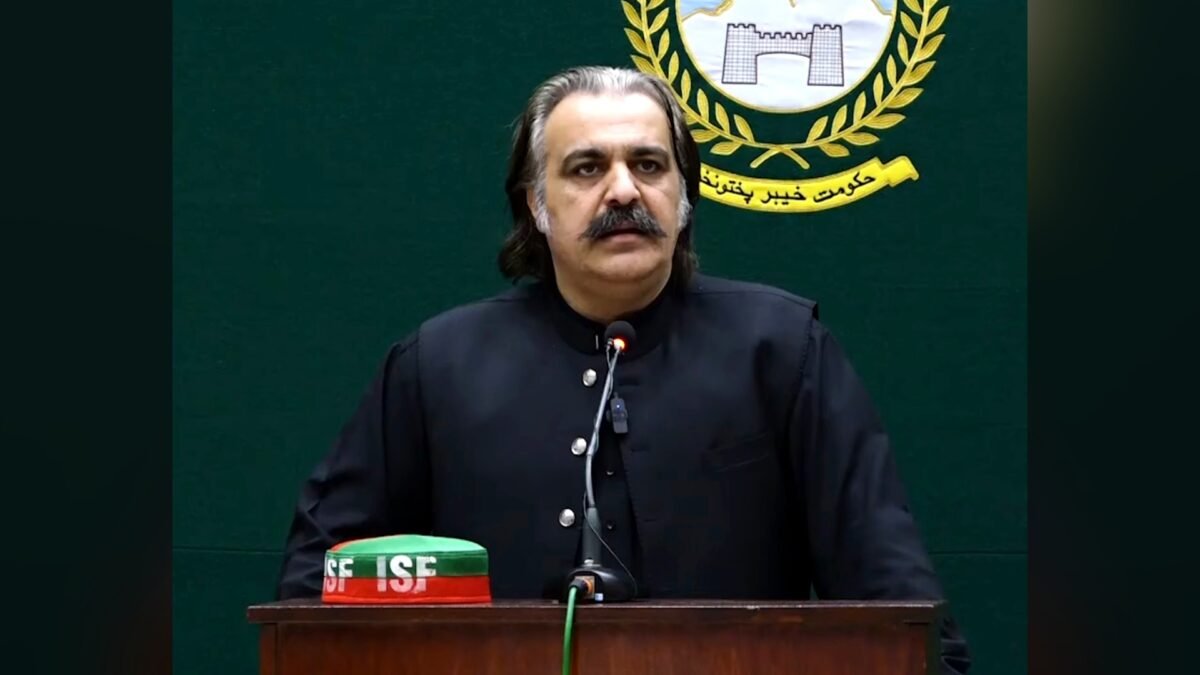
Pakistan Tehreek-e-Insaf, the party of jailed former prime minister Imran Khan, is openly tearing at itself. A bitter public exchange between the party’s secretary general, Salman Akram Raja, and former Khyber Pakhtunkhwa chief minister Ali Amin Gandapur has laid bare the depth of the crisis inside the PTI, coming just days after a failed protest march led to the imposition of federal emergency rule and governor’s rule in the province, according to Dawn.
The row, played out on the social media platform X on Wednesday, centred on a meeting of PTI provincial lawmakers earlier this month at which around 55 members of the Khyber Pakhtunkhwa Assembly backed Gandapur’s nomination as the party’s acting provincial president. The secretary general has angrily rejected that move, accusing the group of acting without the permission of Imran Khan or the party’s political committee — and Gandapur has hit back demanding an apology.
According to Dawn, which reported the story on Thursday, the fissures emerged from what the paper described as the “debacle” of the PTI’s recent protest march — a march that, in the words of a woman parliamentarian from Peshawar quoted in the report, “resulted in the imposition of governor’s rule in KP, and created more problems for their jailed leader”.
The meeting that lit the fuse
The October 14 meeting, held via Zoom and WhatsApp according to one participant, brought together about 55 provincial lawmakers to discuss four issues: party organisation, the status of negotiations with the federal government, plans for further protests, and legal matters, Dawn reported.
Its headline outcome was a handwritten resolution, seen by Dawn and addressed to interim party chairman Barrister Gohar Ali Khan and Secretary General Raja, which said the meeting “unanimously” proposed nominating Gandapur as the acting provincial president in place of MNA Junaid Akbar, who has been missing since the imposition of governor’s rule. The note described the former chief minister as “the right man for the right job”.
That resolution invited derision from Raja, who put the number of the dissident lawmakers at 68 and took a public dig at what he called “the narrative” of a possible announcement by a group of MPAs nominating a new provincial president without permission from the jailed party founder or the political committee, according to Dawn.
Raja went further, accusing the group of cutting off contact with Sohail Afridi — whom he described as the continuing chief minister — and his team in the final days of the protest march, thereby “paving the way for state coercion, emergency and governor’s rule in the province”. He asserted that Ali Asghar, the party’s provincial general secretary, remained the acting provincial head and that Afridi continued as chief minister “in accordance with the law and Constitution”. Concluding his post, he wrote that “those spreading doubts — the snakes and the serpents — will be defeated”, Dawn reported.
Gandapur hits back: ‘No loyalty certificates’
Gandapur’s response was furious. In a series of posts and audio messages on X, the former chief minister demanded that Raja bring to an end what he called “the spectacle” made of the party, and insisted the secretary general had “no right to accuse others of conspiracy, or call them names like ‘snakes and serpents'”, according to Dawn.
“Do you understand this? We know how to make others understand if they don’t get this,” Gandapur said in an angry tone, as reported by Dawn.
He accused Raja of “hiding” during the party’s protest movement and asked what sacrifices the secretary general had rendered for the party. “At a time when the party is facing unprecedented political challenges, levelling vague accusations and using mocking language against your own elected representatives does not befit responsible leadership,” he wrote.
Speaking separately, Gandapur said KP lawmakers needed no “loyalty certificates” and challenged Raja to substantiate his allegations, according to The News. “This party belongs to Imran Khan. We do not need loyalty certificates from anyone, nor does anyone have the authority to pass judgements on our political loyalty or hand us certificates of treason,” he said, describing Raja’s remarks as “regrettable, irresponsible and damaging” to internal unity.
Gandapur challenged Raja to identify exactly whom he was accusing. “First, make it clear who these people are,” he said, asking which lawmakers were being accused of seeking to decide the provincial presidency or the next chief minister without Imran Khan’s or the political committee’s approval. “If you have evidence, name them,” The News quoted him as saying.
He also questioned Raja’s reference to an investigation into the affair: “If an investigation is under way, why does the party not know about it?” — and asked who had ordered it and under which authorised forum it was being conducted.
Gandapur further wondered why Raja and Barrister Gohar had not attended parliamentary party meetings despite repeated invitations to discuss the fallout of decisions that had, in his words, brought the party to its current juncture, Dawn reported.
Others join the blame game
The two men are not the only PTI figures apportioning blame. Dawn reported that a woman parliamentarian from Peshawar echoed the sentiments of many within the core committee when she demanded accountability over the failure of the protest march.
MPA Mashal Yousafzai — a former spokesperson for Bushra Bibi, Imran Khan’s wife — has blamed the former chief minister and a few other party leaders for the failure of the protest march and the subsequent imposition of governor’s rule, according to Dawn.
The episode is not the first time PTI’s internal grievances have been aired on social media. In 2025, ahead of a nationwide protest, Gandapur and then-PTI Punjab organiser Aliya Hamza Malik became embroiled in a similar argument online. That row prompted a censure from Imran Khan, who strictly instructed senior officeholders and junior members alike to avoid expressing “internal differences on social media, electronic media, print media, or any other platform”. “Publicly airing internal matters or individual concerns before the media is entirely unacceptable,” the jailed founder said at the time, according to Dawn.
The backdrop: a province under federal control
The infighting comes as the PTI grapples with the loss of the last major province it governed. The federal government imposed an emergency and governor’s rule in Khyber Pakhtunkhwa on October 11, citing the security situation and accusing the PTI provincial administration of failing to cooperate in the fight against militancy — charges the party denies. Parliament endorsed the measures in a joint session last week, and the province is now administered under federal oversight.
While fighting among themselves, PTI leaders are also pressing the federal government to return to the negotiating table. On Wednesday, the party’s central information secretary, Sheikh Waqas Akram, called on the government to take confidence-building measures “to pave the way for meaningful dialogue”, demanding the reversal of what the PTI described as “unlawful” measures, the restoration of its provincial government’s mandate, and the release of political prisoners, Dawn reported.
Akram demanded the protection of Imran Khan’s constitutional and fundamental rights, including lawful meetings with his lawyers and family and medical treatment under the supervision of his personal physicians in line with court orders. He condemned raids on homes, detentions and pressure on elected representatives and party workers in Punjab and Khyber Pakhtunkhwa, alleging these were intended to intimidate political opponents.
Rejecting Information Minister Attaullah Tarar’s remarks about the party’s political standing — Tarar had said on Tuesday that a formal ban on the PTI was no longer needed after the imposition of governor’s rule — Akram challenged all ruling coalition parties to contest elections against the PTI under a single banner, predicting they would suffer “a crushing defeat in a free and fair contest, even today”.
Analysis: Why It Matters
1. The protest that ate the province
The starting point of this story is not the tweets — it is the failure of the protest march itself. The PTI launched the march to press demands including meetings with its jailed founder and access to his doctors; it ended with the federal government imposing emergency rule and suspending the party’s elected provincial government. Whatever the merits of the original demands, the tactical outcome is beyond dispute: the PTI marched to regain leverage and lost its last major seat of power instead. That reversal is the wound the party is now fighting over, and both Raja and Gandapur are essentially blaming each other for it. For a party whose entire identity is built on street power, losing the streets and the province in one move is an existential shock.
2. A war over who speaks for Khyber Pakhtunkhwa
Strip away the name-calling and the dispute is about something concrete: who legitimately leads the PTI in Khyber Pakhtunkhwa now that the old structures have been shattered. One side says around 55 elected MPAs can nominate an acting provincial president; the other says 68 lawmakers acted without authority and that only the jailed founder and the political committee can decide. The discrepancy in the numbers themselves — 55 versus 68 — tells its own story about how little shared ground remains. In a party where all authority ultimately flows from Imran Khan, and where Khan cannot arbitrate because he is in prison, every faction claims his mandate and no one can prove it. That vacuum is the real engine of this dispute.
3. The ‘snakes’ vocabulary signals a discipline breakdown
Raja’s choice of words — “snakes and the serpents”, “undemocratic decision-makers” — matters beyond its colour. A party secretary general publicly labelling elected legislators as conspirators is the opposite of internal discipline; it is discipline being performed in public because it can no longer be enforced in private. Gandapur’s furious counter-demand for an apology shows the tactic backfired: instead of quelling dissent, the rebuke created a second front. When a party’s leadership starts communicating with its own lawmakers through social media ultimatums, it is a sign that the normal channels — the parliamentary party meetings Gandapur pointedly noted Raja and Gohar did not attend — have stopped working.
4. Fighting each other while fighting the government
The PTI is currently trying to do two contradictory things at once. In the courts, it is challenging the legality of the emergency and governor’s rule; at the same time, its information secretary is demanding the government take confidence-building measures for talks, while its own parliamentary party debates seeking negotiations to restore the provincial government. None of these tracks is compatible with a leadership visibly at war with itself. Governments negotiate with parties that can deliver on their promises; a party whose secretary general and former chief minister are trading accusations of betrayal in public cannot credibly promise either street calm or legislative cooperation. The infighting does not just embarrass the PTI — it weakens every external battle it is fighting.
5. Imran Khan’s absence is the real story
Every actor in this drama invokes Imran Khan’s authority — Raja says the dissidents bypassed him, Gandapur says the party belongs to him, Akram calls him the only leader with nationwide support. Yet Khan himself is silent, jailed, and unable to adjudicate. The 2025 precedent is instructive: when the last public row erupted, Khan personally censured both sides and ordered internal differences kept off social media. This time there is no arbiter, and the row has gone further. Until the question of who can legitimately speak for the founder is settled — by the founder himself or by a process the whole party accepts — episodes like this week’s will keep recurring, each one chipping away at the one asset the PTI still claims: its unity behind its leader.
What to Watch Next
- The courts: The Peshawar High Court has the PTI’s challenge to the emergency and governor’s rule before it, with a hearing scheduled for November 10, and a separate petition has been filed in the Federal Constitutional Court. Any interim relief — or refusal of it — will reshape the political battlefield.
- Talks or no talks: The PTI says it wants dialogue but only after “confidence-building measures”, including reversing the KP emergency. The government’s answer — and whether the parliamentary party’s push for negotiations gains traction — will show if this is posturing or a genuine opening.
- The accountability question: The woman parliamentarian’s demand for accountability over the failed march, and Mashal Yousafzai’s blame of Gandapur, suggest a formal internal reckoning may be coming. Watch for the party’s accountability body to act — or to be ignored.
- Junaid Akbar’s status: The missing provincial president, whose absence triggered the nomination fight, remains unaccounted for in the party’s public statements. His reappearance — or continued absence — will determine whether the acting-president dispute has any resolution.
- Tarar’s ban remark: The information minister’s claim that a formal ban on the PTI is “no longer needed” was a deliberate provocation. Whether the government moves from rhetoric to any legal action against the party will test how far Islamabad intends to press its advantage.
Sources

About the Author — Abdul Mannan
Related Articles
Government Offers Talks as Opposition Insists on Its Terms, Venue Row and Imran Khan Access Demands Stall Dialogue
Islamabad renews its dialogue offer to the opposition, but a venue row, the demand for access to Imran…
PM Shehbaz Announces Rs160 Billion Package for KP on First Peshawar Visit Since Governor’s Rule, Accuses PTI of ‘Callousness’
Prime Minister Shehbaz Sharif on Thursday visited Peshawar for the first time since the federal government imposed an…
Pakistan, Türkiye, Qatar and Indonesia Sign ‘Badr’ Defence MoU in Doha
Pakistan, Türkiye, Qatar and Indonesia signed the "Badr" defence memorandum of understanding in Doha on 21 October 2026,…