
Trump Hugged by Xi in Shenzhen and Shakes Putin’s Hand Ahead of Historic Three-Way Summit

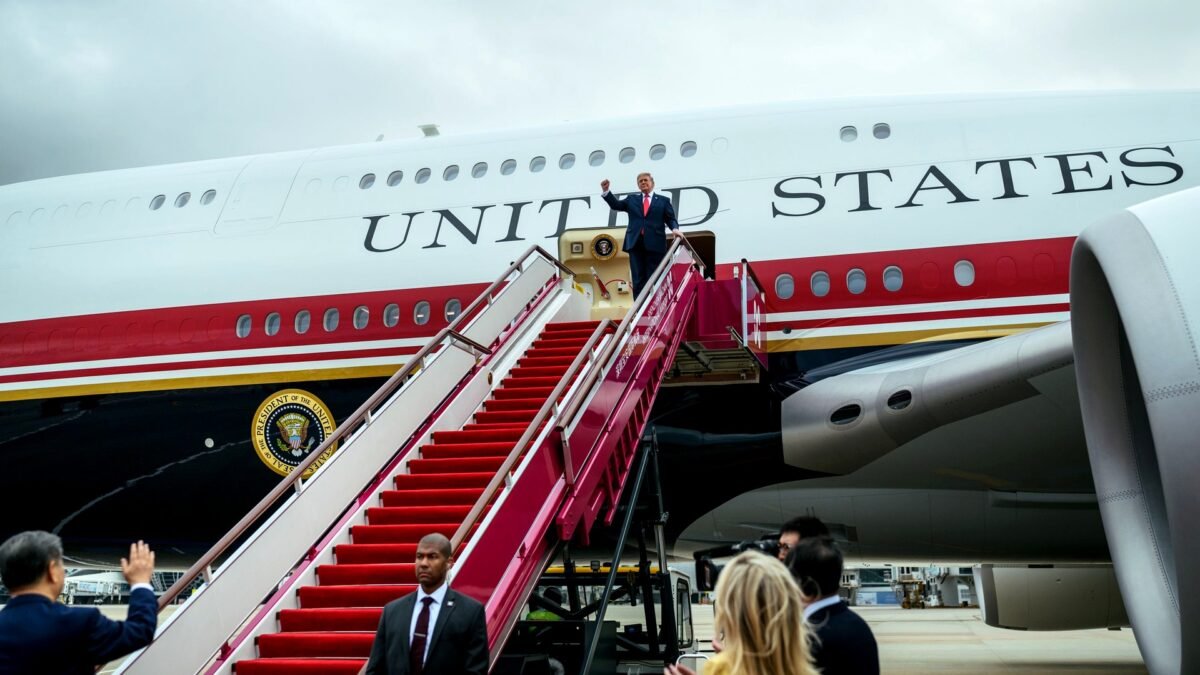
Chinese President Xi Jinping broke with protocol on Wednesday to greet Donald Trump in person as the American president stepped off Air Force One in Shenzhen, embracing him on the tarmac in a gesture no visiting leader has received since Xi took power. Hours later, Trump shook hands with Russian President Vladimir Putin at the Asia-Pacific Economic Cooperation welcome banquet, bringing the leaders of the United States, China and Russia together in public for the first time ahead of their historic three-way summit on Thursday.
The welcome was elaborate and deliberate. A red carpet ran across the tarmac at Shenzhen Bao’an International Airport, a military band played, and dancers waved Chinese and American flags while chanting “warm welcome” in Mandarin, according to Reuters. A little girl presented Trump with a bouquet of flowers. Xi and Trump briefly hugged and exchanged words before walking to their motorcades, Reuters reported.
It was the first time Xi has greeted a visiting leader at the airport since becoming president, according to Reuters, and it was a deliberate act of reciprocity. Trump had greeted Xi in person when the Chinese leader arrived at Joint Base Andrews in September, and Xi was returning the courtesy. “China is a country of etiquette and has a tradition of reciprocating courtesy,” Xi was quoted as saying by China’s state news agency Xinhua. Trump, for his part, said every meeting with Xi has been “very pleasant,” Xinhua reported.
The choreography continued into the evening. After a motorcade took Trump to his hotel, the three leaders joined the other leaders of the 21-member APEC grouping for handshakes, a group photograph and a banquet at Kylin Villa, a five-star resort owned by the Chinese state. Classical musicians performed “America the Beautiful” as Trump arrived for the dinner, according to the New York Post. Xi gave Trump the place of honour next to him in the group photograph and seated him at his side at the head table. Putin approached Trump for a handshake ahead of the meal as Xi stood nearby, in an image carried around the world within the hour.
The three men will meet on the sidelines on Thursday, in the first-ever gathering of the leaders of the United States, Russia and China. According to Reuters, they are expected to discuss Russia’s war in Ukraine and the war in Iran, as well as trade, artificial intelligence and nuclear weapons. Trump has said he wants to use the meeting to talk about limiting nuclear arsenals and bringing an end to the war in Ukraine, which began with Russia’s invasion nearly five years ago.
A welcome no visiting leader has received
The airport greeting was the most watched moment of the day, and its meaning was not left to interpretation. Xi’s decision to meet Trump on the tarmac was, in the words of analysts cited by The Times, the first time in decades that a Chinese leader had received a foreign leader on arrival in the country. Reuters reported it more precisely: the first time Xi himself has done so with any visiting leader since becoming president.
That matters because protocol in Beijing is never accidental. Every element of a state arrival is negotiated in advance, and the presence of the host leader at the aircraft door is the rarest honour in the Chinese diplomatic repertoire. By extending it to Trump, Xi was doing two things at once: repaying the welcome Trump gave him at Joint Base Andrews in September, when the American president met him on the tarmac, and signalling to the rest of the world that the relationship between the two men — and, by extension, between the world’s two largest economies — is being managed at the very top, personally and directly.
Xi’s own words, carried by Xinhua, framed the gesture in the language of tradition rather than strategy. “China is a country of etiquette and has a tradition of reciprocating courtesy,” he said, adding that he looked forward to discussing China-US relations, Asia-Pacific cooperation and the global landscape. He also told Trump on Wednesday that he wanted a “constructive, strategically stable relationship” between China and the United States, according to Xinhua.
It was Trump’s third meeting with Xi this year. He visited China in May and hosted Xi at the White House in September, according to USA Today. The frequency itself is remarkable: three meetings between the two leaders in a single year, at a time when their countries have spent much of the past two years locked in a tariff war. Each meeting has been warmer in tone than the last, even as the substance of their disagreements — over trade, technology and the future of the international order — has barely moved.
The contrast with other arrivals in Shenzhen on the same day was pointed. Leaders from Australia, Canada and South Korea were met by dancers and soldiers hoisting rifles, according to Reuters. Japanese Prime Minister Sanae Takaichi landed without any welcoming ceremony at all. Her visit comes amid a rift between Beijing and Tokyo that began a year ago, after she said Japan could deploy its military if a Chinese move on Taiwan also threatened Japanese territory. The message of the day was plain: in Xi’s China, the warmth of the welcome is a measure of the state of the relationship.
From the tarmac to the banquet table
The day’s second set piece was the APEC welcome banquet, where the three leaders appeared together in the same room for the first time. Trump and Putin had not met since their summit in Alaska in August last year, according to The Times. Their handshake in Shenzhen, with Xi looking on, was brief and formal — a greeting, not a negotiation — but its symbolism was the point. The Kremlin has said it is unlikely that “full-scale” talks will happen between the American and Russian leaders in Shenzhen. “This is a multilateral format. There is hardly going to be time or an opportunity to hold full-scale (bilateral) talks here. No one expects that,” Kremlin spokesman Dmitry Peskov said, according to The Times. Trump, however, has said he is open to a separate meeting with Putin, and has also said he would agree to one-on-one talks with North Korean leader Kim Jong Un.
The banquet also showed how carefully Xi had stage-managed the evening. Giving Trump the place of honour beside him in the group photograph, seating him at the head table, and opening the meal with a call for maintaining “the Asia-Pacific miracle of rapid economic growth” were all choices that put the American president at the centre of the frame — and Xi at the centre of the event. Shenzhen, a city of 18 million that has become the symbol of China’s technological rise, was itself part of the message. In choosing the southern tech hub for the summit, Xi was, as the Wall Street Journal noted, showing off China’s manufacturing strength and its determination to compete at the frontier of technology.
Trump’s day in Shenzhen was not confined to the two set pieces. According to The Times, he also met separately on Wednesday with Mexican President Claudia Sheinbaum and Canadian Prime Minister Mark Carney, both in Shenzhen as members of the 21-nation APEC group. He arrived in China from the Philippines, where he had attended a summit of the Quad nations with Takaichi, Indian Prime Minister Narendra Modi and Australian Prime Minister Anthony Albanese, and where he vowed to deepen defence cooperation with Manila amid its growing friction with Beijing over disputed features in the South China Sea, according to Reuters.
It was Trump’s first trip abroad since his Republican Party’s defeat in the midterm elections this month, according to Reuters. The domestic backdrop travelled with him: allegations involving Nvidia founder Jensen Huang and a suspected Chinese intelligence asset have added tension to the visit, and Washington’s announcement of further restrictions on China’s access to advanced AI chips from companies such as Nvidia has complicated a fragile trade truce with Beijing. China has pledged to retaliate.
Two speeches, two challenges to the West
Before Trump landed, Xi and Putin had already used the APEC stage to deliver pointed speeches of their own — and the two speeches, taken together, amounted to a coordinated challenge to the Western-led order.
Xi, addressing an audience of business executives, urged support for what he called “free and open trade,” and tried to portray China as a stable partner on the global stage, in contrast with the United States, which has raised tariffs and taken a volatile approach to foreign policy under Trump, according to Reuters. “We must firmly uphold the rules-based multilateral trading system with the World Trade Organization at its core, support free and open trade and investment,” Xi said. He added that the world’s second-largest economy will lower tariffs and further open up its markets, while standing up against protectionism and unilateralism, and will continue to invest in its industrial complex and new technologies.
The pitch was aimed squarely at the countries of the Global South, and at the business leaders in the room. “His message is likely to resonate with many Global South countries and reinforces Beijing’s effort to contrast its technology strategy with that of Washington,” George Chen, partner and chair of digital practice at The Asia Group, told Reuters. Western trade partners have criticised China for running annual trade surpluses exceeding $1 trillion through policies that support its manufacturing sector at the expense of its consumers, according to Reuters. Beijing says its growth model is appropriate for an economy still catching up with the world’s richest, but Washington, Brussels and others are concerned about China’s supply chain dominance providing it with geopolitical leverage.
Putin followed Xi on stage with a speech that described Western powers as “former hegemons” and said Europe was in “humiliating decline.” The Russian president, speaking after Ukraine crippled the Kerch road bridge linking Crimea to Russia in a major blow to his four-year-old war, said the anti-Russian sanctions imposed after his invasion of Ukraine had backfired. “Experience has shown that the traditional tools of economic dominance and de facto coercion have largely run their course, having lost much of their intimidating power,” Putin said. “While sanctions, tariffs, and export restrictions may still exert a certain deterrent effect, they are incapable of halting growth — let alone crushing the economies of competitors.” He also praised the close partnership with China and pledged more measures for a “multipolar world,” according to The Independent.
The two speeches were different in tone — Xi the patient builder of an alternative order, Putin the angry critic of the old one — but they shared a target. Both men were telling the same audience, on the same stage, on the same day, that the era of Western economic dominance is ending, and that China and Russia intend to be the ones who write what comes next.
What Thursday is supposed to decide
The trilateral meeting on Thursday is the reason the three men are in Shenzhen, and it is also the part of the week about which least is known. Beijing has confirmed Thursday as the date, but its notice did not set out a detailed agenda, according to the Associated Press. The White House has said the talks will cover nuclear weapons and the war in Ukraine. Reuters reported that the leaders may also discuss the war in Iran, trade and artificial intelligence.
On nuclear weapons, Trump has said he plans to raise the question of limiting the arsenals of the three countries, which together hold the overwhelming majority of the world’s nuclear warheads. It is an ambitious subject for a meeting that the Kremlin itself says will be short on time. On Ukraine, Trump has said he believes a peace deal is imminent — a claim he has repeated for months without producing one. On Iran, the war launched by the United States and Israel on 28 February, according to The Independent, has sent shockwaves through the global economy, and the Strait of Hormuz remains all but closed nearly nine months after the war began. Both Moscow and Beijing have criticised the Iran war, with Xi repeatedly calling on countries to avoid a return to “the law of the jungle,” in what The Independent described as a thinly-veiled dig at Trump’s approach.
The trade question is the most concrete of the three, and the most likely to produce something tangible. The United States imposed sweeping tariffs soon after Trump took office, prompting a tariff war between Washington and Beijing that saw the US impose duties as high as 145 per cent on Chinese goods, according to The Independent. The trade war has since settled, with the two sides agreeing to produce a trade deal next year and agreeing a truce on tariffs. Winding down nearly two years of trade warfare, another defining characteristic of the US-China relationship during Trump’s second term, will also be on the table, The Independent reported.
But the meeting’s real subject may be the meeting itself. It is the first time the leaders of the three countries have sat down together, and the format — a trilateral, on the sidelines of a multilateral summit, in a Chinese city, at China’s invitation — is itself a statement about who sets the terms of great-power diplomacy in 2026. China is the only country that could bring the three together, and Xi knows it.
The Yalta shadow
No comparison has followed the Shenzhen meeting more persistently than the one with Yalta. The 1945 conference between the United States, Britain and the Soviet Union formalised spheres of influence, set the stage for the post-Second World War order and became shorthand for great-power deals imposed on smaller countries, according to Reuters. The parallel has unnerved leaders across Europe and Asia, who fear the world’s greatest military powers will disregard their interests — and it has alarmed Ukraine most of all.
President Volodymyr Zelensky has warned that the summit could be a “new Yalta,” a reference to the 1945 meeting that led to Moscow establishing dominance over swathes of eastern Europe, according to The Times. His foreign minister, Andriy Sybiha, was blunter. “It is very important that through this meeting the two leaders do not give Putin the false impression that we are returning to a period of divided spheres of influence. The tone needs to be different — pressure,” Sybiha told reporters on Wednesday, according to The Independent. Kyiv has urged Trump and Xi to pressure Putin to end the near five-year war rather than trying to appease him.
The Kremlin has dismissed the comparison. It called the Yalta parallel “games of political scientists,” but said the meeting will have a major impact on global affairs, according to Reuters. Beijing said the trilateral will promote world peace. Putin himself described the world as “turbulent” but said disagreements can be addressed by “sitting at the table.” “I therefore expect big potential benefit from the upcoming trilateral meeting,” he said.
Ukraine, sidelined by a format in which its fate may be discussed without its presence, struck a symbolic blow on the eve of the summit. Kyiv hit Putin’s prized Crimea Bridge twice this week, according to The Independent, in attacks that crippled the road section of the 12-mile crossing linking Russia to the Black Sea peninsula it annexed in 2014. The back-and-forth strikes between Moscow and Kyiv have continued unabated, with four people killed in an overnight Russian attack on the port city of Odesa, The Independent reported.
The Yalta comparison is overdrawn in one respect and exact in another. It is overdrawn because the three leaders in Shenzhen are not allies dividing a defeated enemy’s territory, as Roosevelt, Churchill and Stalin were in 1945; they are rivals, and in the case of the United States and Russia, near-adversaries. It is exact because the fear it names is real: that three men in a room in China will decide the future of countries that are not in the room — Ukraine above all, but also Taiwan, the Philippines and the smaller states of Asia and Europe whose security depends on rules the great powers may choose to rewrite.
The road to Shenzhen
The summit did not arrive out of nowhere. Its roots run through a year of diplomacy that has steadily moved the three leaders toward the same table. Xi and Putin met in Shenzhen on Wednesday morning, before Trump’s arrival — their fifth meeting this year, one of them by video link, according to earlier reporting. The Chinese readout of that meeting emphasised the durability of Beijing’s relationship with Moscow and the need to carry out the commitments reached by the two governments, according to the Associated Press.
Behind the summit lies a peace process that has stalled. American envoys Jared Kushner and Steve Witkoff concluded two days of trilateral negotiations in Abu Dhabi and were travelling to brief Putin in Moscow and Zelensky in Dublin, according to reports from the talks. During the meetings, Russian negotiators circulated a document reviving demands for NATO to withdraw its military presence to pre-1997 positions, and Russian Foreign Minister Sergei Lavrov reiterated Moscow’s refusal to accept European calls for an immediate ceasefire. European representatives are expected to join the next round of talks, and Russia and Ukraine have agreed to work toward the largest prisoner exchange of the war — but on the central question of territory, the two sides remain as far apart as ever.
The summit also arrives against the backdrop of a widening war in the Gulf. Iran fired on the Ali Al Salem air base in Kuwait and launched multiple attacks toward Bahrain early on Wednesday, in apparent retaliation for US strikes the previous day, according to the Associated Press — the first Iranian attack on Kuwait since September. The United States has dispatched a third aircraft carrier, the USS Theodore Roosevelt, to the Middle East as tanker attacks in the Strait of Hormuz and Houthi advances near the Bab el-Mandeb strait disrupt key maritime routes. The war in Iran, and the question of how it ends, is now one of the subjects the three leaders are expected to discuss.
And it arrives with Trump’s domestic standing under pressure. His party’s defeat in the midterm elections this month has left him, in the words of one report, wanting to project strength and certainty ahead of a potentially complicated trilateral meeting. A summit with the leaders of China and Russia — photographed together, shaking hands, seated at the same table — is the most visible way to do that. Whether it produces anything more than photographs is the question Thursday will answer.
Analysis: Why It Matters
The hug was the policy
In diplomacy, the photograph is often the policy, and the photograph from Shenzhen airport will be studied for years. Xi Jinping does not hug foreign leaders. He is a reserved man in a reserved system, and the embrace he gave Donald Trump — on the tarmac, in front of the cameras, with a military band playing — was a deliberate message to every capital watching: China has chosen to treat this American president as a partner, not an adversary, and to do so in public. The reciprocity was the point. Trump had greeted Xi at Joint Base Andrews in September; Xi was returning the favour in kind, and in doing so he was telling the world that the two leaders’ personal relationship is the channel through which the US-China relationship will now be managed. For a relationship that has spent two years being conducted through tariffs and export controls, that is a significant shift — even if it is, for now, only a shift in tone.
Putin is back at the centre of the stage
For Vladimir Putin, Shenzhen is a triumph of stagecraft. A leader who was, until recently, treated as a pariah by much of the West — wanted by the International Criminal Court, excluded from the G7 and the G20’s top tables — is now shaking hands with the American president at a banquet hosted by the Chinese president, in front of the cameras, as an equal. The Kremlin understands exactly what that image is worth, and it has worked hard to obtain it. Putin’s speech at APEC, in which he called Western powers “former hegemons” and declared that sanctions had “largely run their course,” was the sound of a man who believes the isolation is over. Whether it is over in substance — the sanctions remain, the war continues, the arrest warrant stands — matters less, for now, than the fact that the isolation is over in the photograph. That is how legitimacy is rebuilt in 2026: not by treaty, but by being seen in the room.
The trilateral is a format, and the format is the message
The most important thing about Thursday’s meeting may not be what is decided in it, but the fact that it is happening at all — and where. A trilateral of the United States, China and Russia has never happened before, and its invention is itself a claim about the shape of the world. It says that the three great powers can settle the affairs of the planet between themselves, on the sidelines of a summit that 18 other leaders are also attending, in a city chosen by Beijing. The format excludes Europe, excludes Ukraine, excludes Japan and South Korea and the Philippines — all of whose futures are on the agenda. That exclusion is not an oversight; it is the point. The Shenzhen format is a test of whether the world will accept a return to great-power management, and the answer will be measured not in communiqués but in how loudly the excluded complain — and how little changes as a result.
Ukraine’s fear is the story’s real stakes
Strip away the ceremony and the Shenzhen summit is about one country more than any other: Ukraine. Kyiv’s warning of a “new Yalta” is not rhetoric; it is a precise description of what the city fears — that the three leaders will trade Ukrainian territory for a wider settlement, just as the great powers traded the futures of smaller nations in 1945. The Ukrainian foreign minister’s demand — “the tone needs to be different: pressure” — is a plea to Trump and Xi not to give Putin the impression that spheres of influence are back. The two strikes on the Kerch bridge this week were Ukraine’s answer in the only language it has left: a reminder, delivered in explosives, that it is still a party to this war and cannot be settled over. Whether Thursday’s meeting produces a ceasefire, a territorial bargain or nothing at all, its most important audience is not in Shenzhen. It is in Kyiv, where every word out of that room will be weighed for what it means for the country’s survival.
The smiles are real. The disagreements are realer.
It would be a mistake to read the warmth of Wednesday as the substance of Thursday. The three leaders smiled, hugged and shook hands — and then, within hours, their governments were back to the business of confrontation. Washington has just imposed new restrictions on China’s access to advanced AI chips, and Beijing has pledged to retaliate. The United States and Iran are at war, and both Moscow and Beijing have condemned that war. Russia is demanding that NATO withdraw to its pre-1997 positions, a demand no Western government will accept. The tariff truce between Washington and Beijing is fragile, the peace talks on Ukraine are stalled, and the three countries disagree fundamentally about the shape of the international order. A hug on a tarmac does not resolve any of that. What it does — and this is not nothing — is keep the three men talking, in the same room, at the same table. In a year when the world’s great powers have spent more time threatening each other than speaking to each other, that is a modest achievement. Whether it becomes more than that depends on what happens when the cameras leave the room on Thursday.
What to Watch Next
- Thursday’s trilateral itself: whether the three leaders issue any joint statement, and whether it mentions Ukraine, Iran or nuclear arms — or amounts to little more than a photograph and a promise to meet again.
- Any Trump-Putin bilateral: the Kremlin says a full-scale bilateral is unlikely in the multilateral format, but Trump has said he is open to one. A separate sit-down would be their first formal meeting since Alaska in August 2025.
- Ukraine’s response: what Zelensky and his government say about the outcome, and whether Kyiv’s warning of a “new Yalta” hardens into open criticism of Washington.
- The nuclear question: whether Trump raises arsenal limits in the room, and whether China — which has historically resisted trilateral arms talks — engages or deflects.
- Trade and chips: whether the meeting produces any movement on the US-China tariff truce, the planned trade deal for next year, or the new American restrictions on advanced AI chips.
- The Iran war: whether the three leaders discuss the Gulf war and the Strait of Hormuz, and whether Russia and China press the United States on a ceasefire.
- The Kim question: whether Trump meets North Korean leader Kim Jong Un during the trip, after floating the possibility — a US official has said no engagement is planned, but Trump has raised it more than once.
Sources
- Reuters, “Xi, Putin blast Western ‘protectionism’ and sanctions as Trump lands in China” (via SRN News), 18 November 2026
- USA Today, “See Trump, Xi hug as China rolls out the red carpet”, 18 November 2026
- The Independent, “Trump, Putin and Xi meet ahead of unprecedented three-way summit as China rolls out red carpet”, 18 November 2026
- The Times, “Putin expects ‘big potential benefit’ from meeting with Trump and Xi”, 18 November 2026
- The Wall Street Journal, “In Choosing Shenzhen for Trump-Putin Summit, Xi Shows Off His Tech Ambitions”, 18 November 2026
- Le Monde, “With Trump and Putin at his side, Xi puts himself front and center on world stage”, 18 November 2026

About the Author — Abdul Mannan
Related Articles
Suspected Russian Aircraft Breach Japanese Airspace as Tu-95 Bombers Land in Vietnam in Biggest East Asia Deployment in a Decade
Two suspected Russian aircraft entered Japanese airspace before dawn on Tuesday, three countries scrambled fighter jets, and hours…
Xi and Putin Meet in Shenzhen on Eve of Historic Three-Way Summit with Trump as Ukraine Fears Grow
Xi Jinping and Vladimir Putin met in Shenzhen on Wednesday, a day before their historic three-way summit with…
Russian Military An-12 Transport Plane Crashes in Siberia, Killing All 19 on Board
A Russian Air Force An-12 transport plane crashed in Siberia on Tuesday, killing all 19 people on board,…