
A Roman Cup in a Steppe Lord’s Tomb: What a 2,000-Year-Old Grave Tells Us About Empires

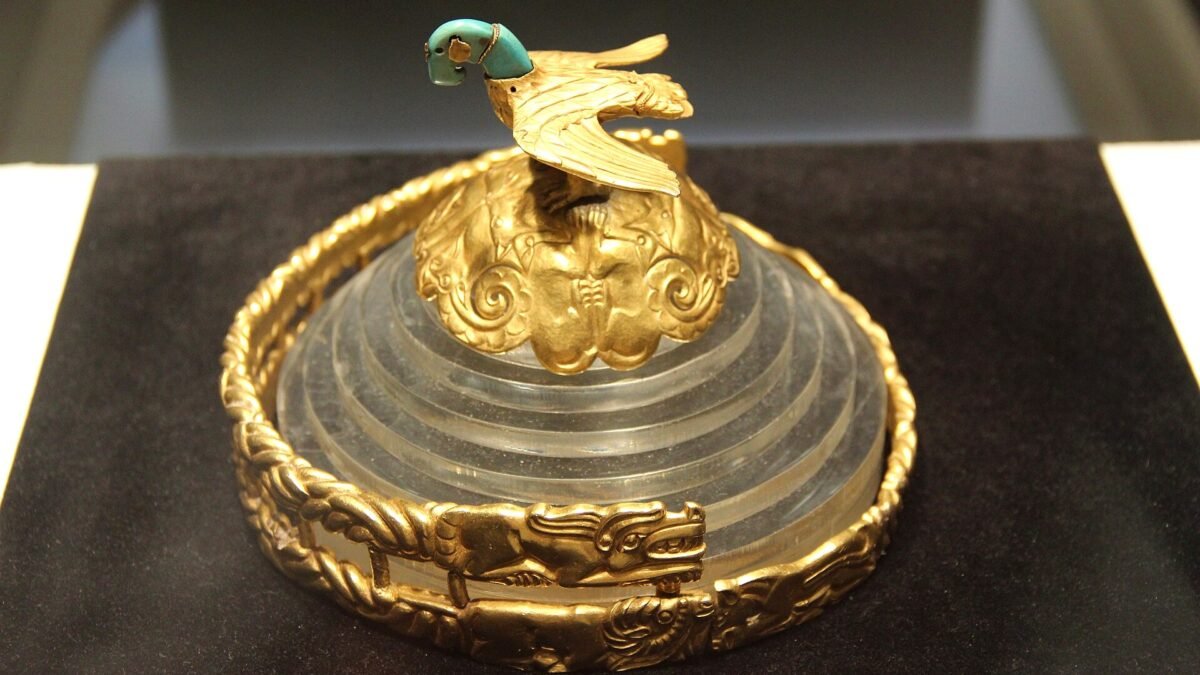
What is a Roman glass doing in a Mongolian grave?
Ask yourself that question slowly, and let it sit. Two thousand years ago, in a windswept cemetery on the edge of the Onon River in what is now north-eastern Mongolia, a powerful person of the steppe was laid to rest. The people who buried him — or her, for we still do not know — raised nine layers of stacked stone over the grave, built a tomb some seventy-three metres long, and filled the small chamber at its heart with treasures gathered from the far ends of the known world. And among those treasures, lying in the dark for twenty centuries, was a glass cup that was very probably made in the Roman Empire.
Read that again. A cup from Rome, in a grave in Mongolia. No aeroplanes. No shipping containers. No internet. And yet the world was already connected — stitched together by roads, rivers, caravans, marriages and ambitions in a way that should humble every person who believes that globalisation was invented in our lifetime.
On 6 November 2026, the National Museum of Korea announced the completion of a four-year excavation of this grave, known officially as Tomb 160, at Duurlig Nars in Khentii Province. The dig was a joint effort by the National Museum of Korea, the Institute of Archaeology of the Mongolian Academy of Sciences and the National Museum of Mongolia. The tomb is the largest Xiongnu burial ever identified in Mongolia, and what came out of it has forced historians to look again at a people the history books long dismissed as mere raiders on horseback.
A Grave the Size of a Street
First, understand the scale of what was built. Tomb 160 stretches about 73 metres — nearly 240 feet, or four-fifths the height of the Statue of Liberty laid on its side — and its central chamber sinks some 14.5 metres into the earth. The builders raised an elevated terrace enclosed by nine layers of stone. It is the largest tomb of its kind ever discovered in Mongolia, standing in a burial ground, Duurlig Nars, that holds some 300 graves and was first discovered in 1974.
And yet here is the detail that stops me cold: for all that monumental effort on the outside, the room that held the body was small and shallow — far smaller than comparable Xiongnu tombs in central Mongolia, whose chambers plunge more than 70 feet deep. The archaeologists read this as a sign of the times. The tomb dates to the late first or early second century CE, when the Xiongnu Empire was already in decline, weakened by internal disagreements and by relentless pressure from the Han military. Even in decline, even with a smaller chamber, the burial still demanded 413 artefacts of extraordinary quality: a lacquered chariot, fifteen pieces of jade modelled after Han funerary goods, a gourd-shaped silver pendant set with a crystal that once adorned a horse’s harness, and that glass cup — found broken, its Roman origin still to be confirmed by testing the composition of the glass.
Think about that. An empire in its twilight still buried its dead like kings. That is what empires do. They keep up the ceremony long after the power has gone. The tomb is a monument to pride as much as to grief — and pride, I have learned from history, is usually the last thing an empire loses.
The Cup That Crossed the World
But it is the cup that matters most, because the cup is not a local product. The museum itself put it plainly: “This excavation clearly shows that the Xiongnu of 2,000 years ago were linked to a broad exchange network reaching from Rome to the Korean Peninsula.”
From Rome to the Korean Peninsula. Say those words out loud and measure the distance. The glass, if the tests confirm what the archaeologists suspect, was blown in a Roman workshop, carried across thousands of miles of desert and steppe, passed from hand to hand through merchants, middlemen, diplomats and gift-givers, until it reached a nomad lord on the Mongolian steppe — who valued it enough to take it into the grave. Beside it lay jade shaped in the Han Chinese manner, and a silver pendant of a kind found in the tombs of Lelang, the Han commandery based in what is now Korea. Rome, China and Korea, meeting in a single burial chamber in Mongolia.
We are told that the ancient world was a world of isolated civilisations, each behind its own wall, each suspicious of the other. The grave at Duurlig Nars says otherwise. It says that two thousand years ago, goods, ideas and people were already moving across the whole of Eurasia. The Silk Road was not a single road at all. It was a web — and the steppe peoples were not standing outside that web. They were its weavers.
The “Barbarians” Who Ran the World
And here is where history holds up its mirror to us, and we should have the courage to look into it.
The Xiongnu dominated Central Asia for some three hundred years, from the third century BCE to the second century CE. They did it, as one historian has written, “without building cities, forming central bureaucracies, devising a writing system or mobilising masses of farmers to produce food.” They were nomads. They moved. And because they moved, the settled empires on either side of them — Rome in the west, Han China in the east — called them barbarians.
Barbarians. That is the word every settled empire uses for the people it does not understand and cannot control. The Romans used it. The Chinese used it. The British used it in India. Every age has its own version of the word, and every age is equally wrong.
For the truth, which the grave now shouts from the ground, is that these so-called barbarians ran one of the most sophisticated political systems of the ancient world. Recent scholarship has shown that elite Xiongnu women travelled to the empire’s frontiers to shore up alliances through marriage — “representatives of the imperial clan that ruled the empire,” as the archaeologist Bryan Miller of the University of Michigan has described them. “You’ve got these marriage alliances spanning the whole empire, even in these local communities.” This was not a rabble. This was an empire organised around moving populations, ruled by elites who were, in Miller’s words, “savvy politicians who delegated power to keep the empire together.”
Reader, I ask you: how many of our own certainties will look this foolish two thousand years from now? We still divide the world into the civilised and the backward, the developed and the developing, the centre and the periphery — the same old wall, painted in new colours. And still, as in the days of the Xiongnu, the people we dismiss are the ones holding the threads that connect the world together.
Every Empire Believes It Is Forever
There is a second lesson in this grave, and it is a harder one. The tomb was built as the Xiongnu Empire was falling apart. Internal disagreements. External pressure. A great confederation that had dominated the steppe for three centuries was coming undone — and its lords responded the way falling powers always respond: with bigger monuments, richer burials, and a fiercer insistence that nothing had changed.
History is full of this pattern, and I have spent my life watching it repeat. Empires do not fall in a single day. They rot from within while the ceremonies grow grander. Rome fell the same way, centuries later — its emperors still minting coins, still staging triumphs, while the frontiers crumbled. The East India Company once believed its ledgers would rule India forever; its ruins now sit in museums, beside the Xiongnu gold. The names change. The pattern does not.
That is why this discovery matters beyond archaeology. In July 2026, UNESCO added “The Cemetery Complexes of the Xiongnu Nobility” — eight burial grounds across Mongolia, Duurlig Nars among them — to the World Heritage List, recognising the tombs for highlighting “the engineering and organisational skills of this predominantly nomadic culture.” The world has finally, formally, admitted what the grave always knew: that greatness does not belong only to those who build cities and write chronicles. Sometimes it belongs to those who move, who connect, who carry a Roman cup across a continent and set it beside their dead.
What the Dead Lord Is Still Saying
We still do not know who lies in Tomb 160. The researchers plan a DNA analysis of teeth and hair recovered from the coffin to determine the person’s sex and age. Perhaps we will learn a name, or a lineage, or a cause of death. Perhaps we will learn nothing more than we know today — that this was someone important enough to be buried with the wealth of three worlds, at the very moment their world was ending.
But I believe the grave has already told us everything that matters. It has told us that no wall, no border and no empire ever truly separated the peoples of this earth — not two thousand years ago, and not today. It has told us that the people history calls barbarians are often the ones who understand connection best, because they live by it. And it has told us, with the quiet authority of the dead, that every empire believes it is forever, right up until the day it is not.
So I leave you with the question I began with, and I ask you to carry it with you: what is a Roman glass doing in a Mongolian grave? It is there because the world was always one world — and because the men who thought they owned it were only ever passing through. The cup survived. The empire did not. Remember that the next time someone tells you that their power, their system, their order of things will last forever. History has heard that promise before. It is buried, with full honours, in Tomb 160.
Sources & References
- Smithsonian Magazine — “A Roman Cup and Hundreds of Other Treasures Unearthed in This 2,000-Year-Old Tomb Reveal the Rich Exchange Network of an Ancient Asian Empire” (20 November 2026)
- UNESCO World Heritage Centre — “The Cemetery Complexes of the Xiongnu Nobility” (inscribed July 2026, property 1759)
- Seoul Economic Daily — “Mongolia’s Xiongnu Tombs, Excavated with Korea’s Help, Named World Heritage” (28 July 2026)
- The Ancient Sky — “A Steppe Lord’s Giant Tomb in Mongolia Held a Glass Cup That May Have Come From Rome”
- Wikimedia Commons — Featured image: Warring States Xiongnu gold crown, photographed by Gary Todd (CC0)

About the Author — Abdul Mannan
Related Articles
Thirty-Eight Souls and a Skull Painted Red: What the Unlooted Tomb of Chan Chan Asks of Us
For six centuries, beneath the adobe walls of Chan Chan, thirty-eight souls waited in the dark — a…
The Rooster That Still Rattles: What the Boy of Tomis Says to Us After 1,800 Years
In Constanța, Romania, archaeologists opened a sealed Roman sarcophagus and found a child buried with his toys —…
The Floor That Outlived Its Owner: Lessons from a 2,000-Year-Old Mosaic in Türkiye
Archaeologists in Türkiye uncovered a 2,000-year-old mosaic at Kültepe-Kanesh — the first in 78 years of excavation. A…