
Nearly 1,000 Migrants Cross the Channel in Two Days as Arrivals Resume After Three-Week Weather Pause

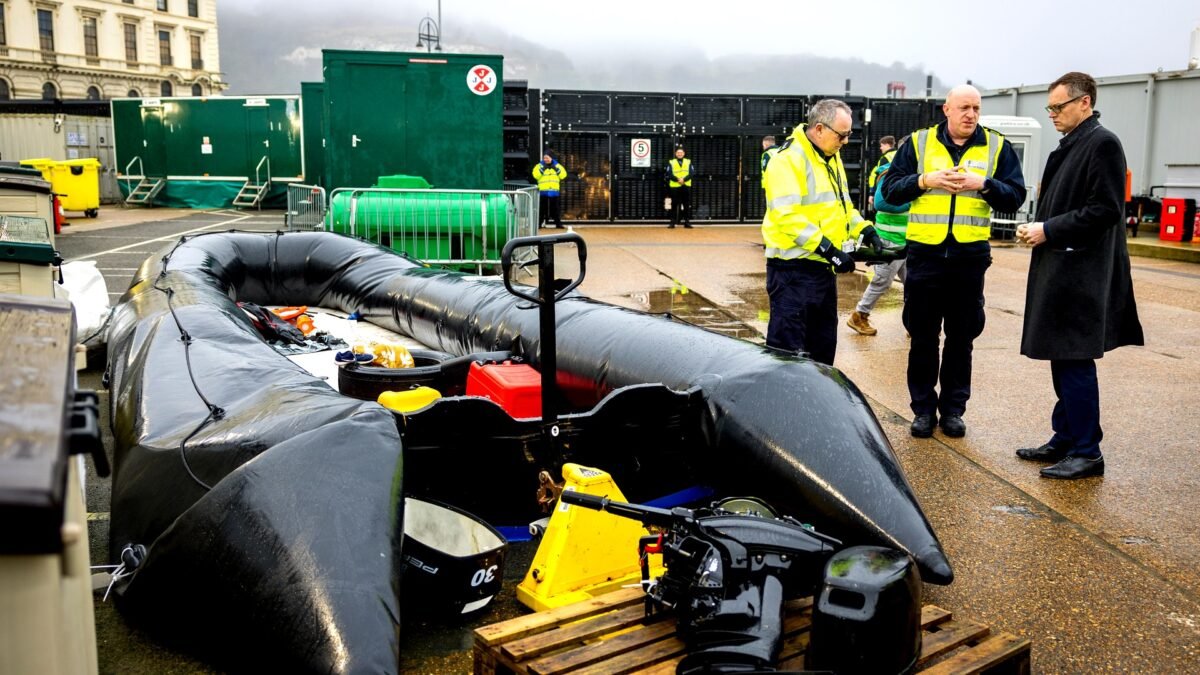
Nearly 1,000 people crossed the English Channel in small boats in just two days, ending a three-week pause in arrivals and handing the Government a fresh political test over a migration policy whose flagship returns deal with France expired only a month ago.
According to Home Office figures reported by the Press Association, 671 people arrived in nine boats on Friday, 30 October, a day after 263 people crossed in three boats on Thursday, 29 October. The two-day total of 934 brought the number of arrivals for 2026 to 21,869.
The crossings broke a 21-day hiatus, the longest spell without arrivals this year, which officials attributed to high sea swell and strong winds in the Channel. Several children were among a large group of people wearing life jackets who were brought ashore in Dover, Kent, as calmer conditions returned.
The resumption came with a reminder of the danger and disorder that surrounds the crossings. In footage captured by the Press Association on Friday, a man was seen moving towards a boat in waist-deep water holding a knife, while a man aboard the boat tried to hit him with a boot. As the man in the water drew his arm back, he appeared to drop the knife into the sea and moments later boarded the UK-bound boat. A call of “I will kill you” was heard as French rescue boats hovered a short distance away.
Separately, 38 people were rescued off the coast of the southern Netherlands in the early hours of Saturday morning from a rubber boat which had no motor and was drifting off the coast of Zeeland province. Two people were detained on suspicion of people smuggling, and it was unclear where the group had come from or where they were heading.
The two days in detail
Thursday’s arrivals ended the 21-day break. One of the three boats that crossed that day had been customised in the colours of the Kurdish flag — red, white and green with a golden sun emblem — and was reported to have launched from Belgium. Iraqi Kurds are believed to be key players in the organisation of Channel dinghy crossings, according to the Press Association.
At least two boats were seen by the Press Association leaving the French coast in the early hours of Friday, and by the end of that day nine boats had reached Britain carrying 671 people — more than double the previous day’s total.
The scale of the two-day surge was striking, but it did not change the broader picture for the year. After Friday’s arrivals, the 2026 total stood at 21,869, according to Home Office figures. That is down 43 per cent on the same point last year, when 36,954 people had arrived, and 29 per cent below the figure at the same stage in 2024, when 29,867 had crossed.
With just over two months of the year remaining, and with crossings typically lower during late autumn and winter, the data suggests the total for 2026 is unlikely to surpass the figure for 2025, when 41,472 people crossed — the second-highest annual total on record after 45,755 in 2022. More than 210,000 people have arrived by small boat since 2018, according to Home Office data.
The Government has pointed to the year-on-year fall as evidence that its approach is working. A Home Office spokesperson said: “We have made progress tackling the small boats. Crossings are down significantly, and we have just recorded the lowest number of summer arrivals since 2020.”
The same spokesperson said joint efforts with international partners had prevented more than 50,000 crossing attempts and seized 1,100 boats and engines since the election.
Behind the headline numbers, the human cost of the crossings continues. At least 2,182 children have made the 21-mile crossing alone since January, according to figures from Kent County Council. On 28 September, three migrants, including a 10-year-old child, died while attempting to reach Britain aboard an overcrowded inflatable boat from the French coast.
The politics: ‘lost control of our borders’
The Conservatives seized on the new figures. Shadow home secretary Chris Philp said the figures showed Labour had “lost control of our borders”.
“The boats keep coming, the smugglers keep operating and Labour keeps making excuses,” Mr Philp said. “Labour is too weak to stop the boats. Andy Burnham is more concerned with appeasing his left-wing backbenchers than taking the tough action needed to secure our borders and deport illegal immigrants.”
Mr Philp added: “Only the Conservatives have the backbone to deliver a borders plan including leaving the ECHR and deporting all illegal immigrants. That is how we end the crisis in the Channel.”
The criticism lands at an awkward moment for the Government. Its flagship returns arrangement with France — the so-called “one in, one out” deal — stopped processing new cases on 1 October 2026, a month before the crossings resumed in force.
Under the pilot, which began operating on 6 August 2025, Britain could return some small boat arrivals to France in exchange for accepting an equal number of asylum seekers from France considered likely to qualify for protection, with priority given to vulnerable nationalities and people with family or other links to Britain. The first removal took place on 18 September 2025.
Official figures show that 1,087 people were returned to France between 4 August 2025 and 30 June 2026, while 1,117 were transferred to the UK under the scheme. Over the same period, 27,920 migrants arrived in the UK on small boats, meaning only about 4 per cent of arrivals were sent back. The Government later told the House of Lords that more than 1,500 people had been returned in total.
Home Secretary Shabana Mahmood told MPs on 15 September that it cost the UK taxpayer an average of about £56,000 per migrant to return them under the scheme. France declined to renew the pilot when it reached its scheduled end, Reuters reported, and the Home Office confirmed it was no longer processing new cases, although flights would continue for cases already in the system.
Prime Minister Andy Burnham, who succeeded Sir Keir Starmer in July, has said his government is “changing the whole approach” to small boats, pairing tougher enforcement with safe legal routes for asylum seekers, which he argues would take away the smuggling gangs’ main selling point. He has declined to set a date for ending the crossings, but told the BBC he and Ms Mahmood would not stop until they had cracked down on “every element of this criminal, illegal activity”.
Mr Burnham has also said that Brexit made stopping small boats harder because the UK no longer has the same level of cooperation with the European Union.
A wider launch map
The crossings are also spreading geographically. Migrants are now using a 325-mile stretch of Channel coast across Belgium and France to launch small boats to the UK, according to The Sun, which reported that Belgian police had confirmed a spike in crossings from Belgium after none in 2025.
Belgian government officials confirmed that more than 400 people had been intercepted trying to cross the Channel from Belgium in the past 10 months, compared with none throughout 2025. The Kurdish-flag boat that arrived on Thursday was reported to have launched from Belgium.
The shift matters because it stretches the policing task. French and Belgian authorities must now watch a far longer coastline, and the smuggling networks have shown they can move their launch points when pressure increases in one place. The rescue of 38 people drifting off the Dutch coast underlines how far the routes can extend when boats lose power or drift with the tide.
Meanwhile, the Government’s enforcement machinery continues to operate in parallel. The Border Security, Asylum and Immigration Act, which came into force on 5 January 2026, gave the authorities new powers to seize electronic devices from illegal migrants and created offences targeting small boat smuggling and concealment in vehicles.
The Border Security Command brings together law enforcement, intelligence sharing and international cooperation to disrupt smuggling networks. The National Crime Agency’s capabilities have been boosted with an extra £100 million in funding, paying for up to 300 extra officers and new detection technology.
Official figures show that in the year ending September 2025, there were 3,162 disruptions of organised immigration crime conducted by public bodies, 33 per cent more than in the previous year, when there were 2,374. The number of disruptions has risen steadily from an average of 392 per quarter in 2023 to 791 per quarter in the latest year.
Analysis: Why It Matters
1. The numbers tell two stories at once
The most important thing to understand about this weekend’s figures is that both sides in the argument are, in a narrow sense, right. Crossings in 2026 are running 43 per cent below last year’s pace, and the summer saw the lowest arrivals since 2020. That is a real and substantial fall, and it is the figure the Government will repeat. At the same time, 934 people arrived in two days, in plain sight, after a three-week pause that was caused by the weather rather than by any policy. Both facts are true, and the political argument is really about which of them the public remembers. The Government’s case rests on the trend; its critics’ case rests on the pictures. Neither side can wish the other’s evidence away, and that is why the issue remains so politically potent even as the numbers fall.
2. Weather, not policy, set the timetable
The 21-day pause was the longest of the year, and it ended the moment the sea calmed. That is the uncomfortable truth at the heart of this story: the single biggest determinant of whether boats cross on any given day is still the weather. Ministers can claim credit for the annual decline, and the decline is real, but the two-day surge shows how quickly the picture can change when conditions improve. A policy that depends on the Channel staying rough is not a policy at all. The test of the Government’s approach is not what happens on a stormy week in October, but what happens on a calm week in May, when the crossing season traditionally begins in earnest.
3. The returns deal ended without a replacement
The “one in, one out” scheme was always modest in scale — it returned about one in 25 arrivals — and at £56,000 per return it was extraordinarily expensive. Its defenders argued it was a pilot, a proof of concept, and that its value lay in establishing the principle that arrivals could be returned to France at all. Its critics argued that a scheme which returns 4 per cent of arrivals can never deter anyone. Both critiques miss the more important point: the scheme has now ended, France declined to renew it, and there is no replacement in place. The Government says it will use lessons from the pilot to accelerate returns, and that flights continue for cases already in the system, but a month after the deal’s expiry the UK is, in practical terms, back to having no returns arrangement with France. The crossings that resumed this weekend arrived into that vacuum.
4. The gangs are adapting faster than the enforcement
The widening of the launch area to a 325-mile stretch of coast, the use of Belgium as a departure point, and the appearance of a boat painted in Kurdish flag colours all point to the same conclusion: the smuggling networks are organised, flexible and well informed. They shift launch points, change tactics and exploit gaps in policing faster than two governments can close them. The knife incident captured on camera on Friday — a man threatening fellow passengers as he forced his way onto a boat — is a reminder that these networks operate with violence and intimidation, and that the people on the boats are often victims as well as law-breakers. Enforcement successes are real: more than 50,000 crossing attempts prevented, 1,100 boats and engines seized, and organised crime disruptions up by a third. But the gangs’ ability to move along the coast suggests that enforcement alone, however well resourced, will struggle to end the crossings without a workable returns arrangement and legal routes that undercut the gangs’ business model.
5. The asylum system is still carrying the cost
Every arrival enters an asylum system that remains under enormous strain. At the end of June 2026, 16,021 asylum seekers were housed in hotels, down 50 per cent on a year earlier — genuine progress, but still a large number of people in expensive temporary accommodation. The National Audit Office found in May 2025 that the cost of asylum accommodation contracts had risen from an estimated £4.5 billion to £15.3 billion over ten years. Those figures explain why the crossings matter far beyond the beaches of Kent: each boat that lands adds to a backlog, a bill and a political argument that no government has yet resolved. The fall in arrivals this year eases the pressure, but it does not remove it, and a single calm week in spring could reverse the trend in a matter of days.
What to Watch Next
- Whether the surge continues: The key question is whether the two-day total of 934 was a weather backlog clearing at once, or the start of a sustained late-autumn run. Daily Home Office figures over the coming week will show whether arrivals settle back to the lower 2026 pattern or climb again.
- A new returns arrangement: With the France deal expired and no replacement announced, watch for any new agreement with France or another European partner — and for the price, in money and in legal admissions, that the UK is prepared to pay for it.
- The Immigration and Asylum Bill: The Bill now going through Parliament is the Government’s main legislative vehicle for its new approach. Its progress, and any amendments on detention, returns and legal routes, will shape what happens next spring.
- The Belgian coastline: If launches from Belgium continue to grow, expect pressure for a formal cooperation agreement with Brussels similar to the one with Paris — and expect the gangs to keep probing for the next gap.
- The winter lull and the spring rise: Crossings usually fall in late autumn and winter and rise again in spring. The Government will want to use the quiet months to put a returns system in place; its critics will judge it on what happens when the weather turns in March and April.
Sources
- Press Association via Glasgow Times — Nearly 1,000 migrants cross Channel in two days after three-week pause
- Press Association via Clacton and Frinton Gazette — Almost 265 Channel migrants arrive in UK after three-week hiatus
- Walaw — UK-France migrant exchange deal ends as Channel crossings remain a major challenge
- Breaking Brexit News — Small Boat Crossings Explained: Figures and Costs
- Internewscast — Clashes Reported as 671 Migrants Arrive by Packed Small Boats

About the Author — advmannan1
Related Articles

Burnham ‘Open’ to Slavery Apology but Rules Out Reparations Ahead of Commonwealth Summit
Prime Minister Andy Burnham says Britain is open to a formal apology for the transatlantic slave trade, but…

Mahmood Set to Soften Settlement Plan as Care Workers Win Exemption
Home Secretary Shabana Mahmood is expected to announce a softened settlement package next week, with social care workers…

Miliband Tells Lavrov ‘We All Know You Are the Aggressor’ as G20 Family Photo Is Scrapped
Britain's Foreign Secretary confronted Russia's Sergei Lavrov face to face at the G20 in Atlanta, telling him 'we…