
Erdoğan and Zelenskyy Agree to Rebuild Black Sea Grain Corridor as Türkiye Warns Ukraine War Is ‘No Longer Sustainable’

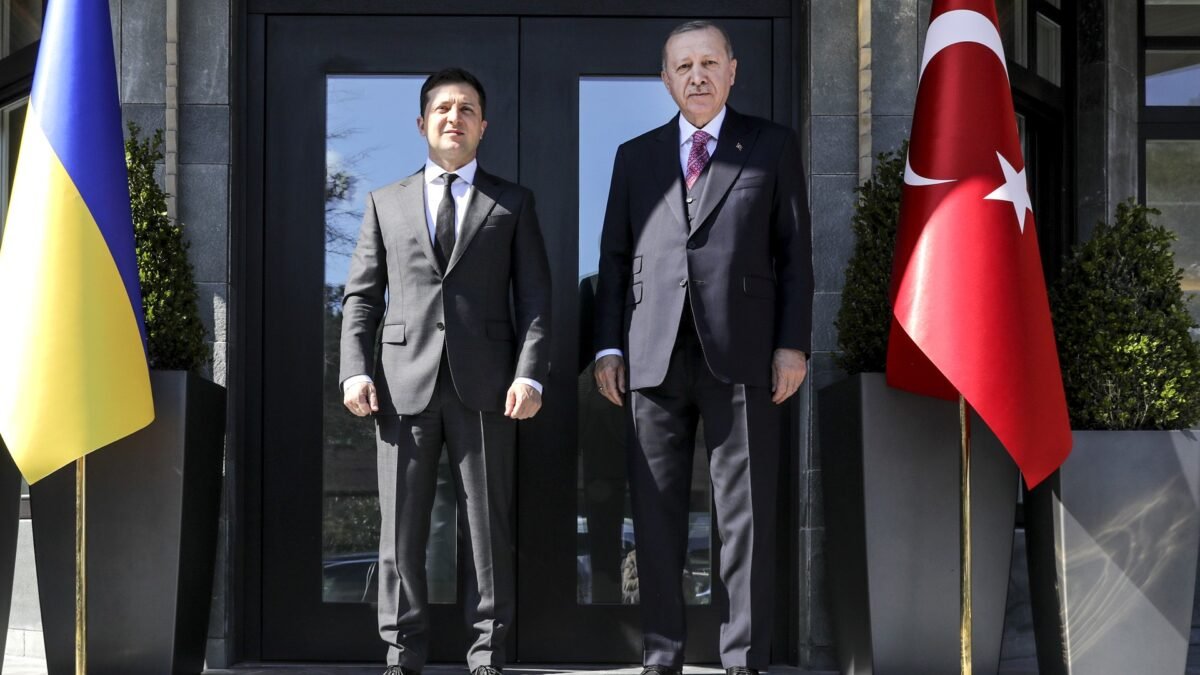
Turkish President Recep Tayyip Erdoğan and Ukrainian President Volodymyr Zelenskyy agreed in Istanbul on Saturday to work on rebuilding a safe Black Sea grain corridor, as Türkiye warned both Russia and Ukraine to stop attacking civilian ships and its foreign minister declared that the war in Ukraine had become “no longer sustainable”. The agreement, announced at a joint news conference at the Dolmabahçe working office, came after a month in which drone attacks sank or damaged at least six commercial vessels in the western Black Sea and left about two dozen seafarers dead or missing, according to Al Jazeera.
“Today, I reached an agreement with President Erdoğan to work on the Black Sea grain corridor,” Zelenskyy said, according to Al Jazeera. Erdoğan said attacks on civilian vessels were unacceptable, whoever carried them out. “It is clear that attacks against civilian ships and actions that further escalate tensions in the Black Sea serve no one’s interests,” he said. “We cannot accept these attacks under any circumstances, regardless of who carries them out or what justification is offered,” he added, calling on all parties to “act responsibly”.
The meeting in Istanbul was the latest step in a diplomatic push that now stretches across three fronts at once: a Turkish effort to protect shipping in the Black Sea, a United States-backed attempt to restart trilateral talks between Ukraine, Russia and the United States in early November, and a warning from Ankara that the economic damage of the war — compounded by the closure of the Strait of Hormuz — has become too heavy for Europe and the wider world to keep absorbing. Whether any of it produces a concrete agreement will depend first on Moscow, which has not yet answered Türkiye’s proposal to halt attacks on civilian ships, according to Reuters.
A corridor, not yet a deal
The two presidents discussed the prospects of holding trilateral talks between Ukraine, Russia and the United States in early November, as well as other possibilities “including ways to involve Türkiye and all of Europe”, Zelenskyy said at the Istanbul news conference, according to The Guardian. The Kremlin said last week that the next round of talks between Russia, Ukraine and the United States was planned to resume in November in the United Arab Emirates, according to Al Jazeera. Zelenskyy said he had discussed that format with Erdoğan, along with other options, including the possibility of a meeting in Türkiye.
Erdoğan said talks aimed at restoring the safety of navigation in the Black Sea would continue. “I believe that reaching an agreement on this issue would also give fresh impetus to efforts to secure lasting peace in Ukraine,” he said, according to Al Jazeera. He welcomed what he called renewed momentum behind efforts to end the war through diplomatic means, pointing in particular to the initiative of United States President Donald Trump. “At this point, we maintain that there can be no losers in a just peace,” Erdoğan said, adding: “I would like to emphasise that we stand ready to make every possible effort to pave the way for peace.”
Türkiye has hosted several rounds of talks between Russia and Ukraine aimed at a lasting ceasefire and peace deal, which Erdoğan said showed that “tangible results can be achieved through diplomacy”. In a phone call with Trump on Wednesday, Erdoğan said Türkiye was ready to support efforts to revive the diplomatic process and end the war, according to the Turkish president’s office.
No operational details of a new corridor have been released — no routes, no volumes, no timeline, and no indication of whether Russia has agreed to anything. Zelenskyy himself was careful to frame the agreement as work to be done rather than a deal already struck. Ukrainian media noted that the announcement did not mean a new deal with Russia had been reached, according to Clash Report. What was agreed, in substance, was that Türkiye and Ukraine will work together on restoring safe passage, and that Ankara will keep pressing both sides to stop shooting at ships.
Ankara has already sent Moscow and Kyiv a proposal to end attacks on civilian ships, but neither side has acted on it, according to Reuters. Erdoğan disclosed the proposal at the news conference and said Türkiye would continue talking to both sides. Zelenskyy accused Russia of making the situation in the Black Sea difficult and said a significant part of his conversation with Erdoğan had focused on security there.
The visit also produced practical agreements beyond shipping. Zelenskyy said Ukraine expected Turkish deliveries of generators and other equipment for its battered energy grid as early as next week, according to EA WorldView. He also pointed to “new joint industrial and other economic projects” under a free trade agreement between the two countries that entered into force on 1 October, noting “significant potential in energy and infrastructure”. Erdoğan reaffirmed Ankara’s commitment to Ukraine’s territorial integrity, sovereignty and independence, calling Kyiv a strategic partner, and noted that the free trade agreement brought the two countries closer to a bilateral trade target of $10 billion.
Zelenskyy used the Istanbul appearance to link the Black Sea question to the wider war. “Strong decisions are needed to bring peace. At every level, Russia must be sent signals that there is no alternative to peace and that support for Ukraine will not diminish. This is all the more important given that a humanitarian operation took place in Oleshky, in the Kherson region, over the past few days,” he said, according to The Guardian. He was referring to the evacuation of starved residents from the Russian-occupied town of Oleshky under a six-day local ceasefire, which he has said “clearly demonstrates that de-escalation steps are possible when Russia is the one put in a position where it has to take steps toward de-escalation”.
A month of attacks on civilian ships
The urgency behind the Istanbul meeting is written in the casualty list of the past month. On 5 October, drones sank the Turkish-owned grain carrier Royad Mammadov in Romania’s exclusive economic zone, and two crew members died, according to Clash Report. Zelenskyy blamed Russia for that strike, while Romania named no suspect. The next day, drones hit two ships off Bulgaria: the Alfa Watan, reportedly Turkish-owned, sank, and its 10 crew are presumed dead, according to the BBC. On 13 October, the HS Dignity sank in the same area with 10 crew missing, and Bulgaria’s defence minister said it assumed the drones were Russian, according to Clash Report. The Malta-flagged Chelsea 3 was damaged in a separate attack around the same time.
On 23 October, a foreign-flagged cargo ship capsized and sank in the Black Sea following a suspected drone strike about 13 nautical miles off the Romanian port city of Constanta, according to Assafina. Then, on 28 October, three maritime drones struck the Liberian-flagged container ship Contship Jet about 21 nautical miles southeast of Cape Kaliakra, in Bulgaria’s exclusive economic zone, while it was sailing from Haifa in Israel to Constanta in Romania carrying 421 containers, according to Assafina and the Bulgarian government. The crew of 18 — 14 Filipinos and four Ukrainians — abandoned ship and were rescued and transferred safely to the Bulgarian port of Varna, according to the Bulgarian government. The ship later sank.
A French Navy Atlantique 2 maritime patrol aircraft had detected the three surface drones approaching the Contship Jet and warned the crew, passing the vessel’s coordinates to the relevant authorities and alerting other ships in the area — but the early warning did not prevent the attack, according to the French military. The incident took place on the same day that defence ministers from Bulgaria, Romania and Turkey were meeting in the Bulgarian capital, Sofia, for trilateral talks focused on security in the Black Sea region.
At least six ships have been attacked by drones off Bulgaria this month, and about two dozen seafarers are feared dead, according to the Bulgarian government. The Financial Times, citing data from the maritime security firm Ambrey and the International Maritime Organization, reported that more than 570 vessels have been hit in the Black Sea this year and that at least 40 seafarers have been killed, according to Clash Report. The attacks in the exclusive economic zones of Bulgaria and Romania — both members of the European Union and NATO — have led some members of the alliance to wonder whether Russian President Vladimir Putin is seeking to test their support for Ukraine, according to Assafina.
Russia has not taken responsibility for the attacks, but suspicion has increasingly fallen on Moscow, according to Assafina. On 15 October, NATO Secretary-General Mark Rutte said in a post on X that NATO had “strengthened our posture along the eastern flank including with increasing counter-drone capabilities” in the face of the increasingly frequent strikes on commercial vessels. Bulgaria, a member of the European Union and NATO, has sought assistance to bolster security off its Black Sea coast. On 28 October, Turkish Defence Minister Yaşar Güler warned both sides in Sofia that Ankara reserves legal rights over attacks on Turkish-linked ships, according to Clash Report.
Throughout the war, Russia has repeatedly bombarded Ukraine’s Black Sea and Danube river ports, leaving Kyiv increasingly reliant on alternative routes to get its grain exports to markets in Africa and the Middle East, according to Assafina. Russian drones have repeatedly violated Romanian airspace near some of Ukraine’s Danube ports. The attacks on shipping now threaten a global trade route and have left two people dead, with at least 25 still missing, according to Assafina’s account of the October incidents.
Fidan: “These wars are no longer sustainable”
While Erdoğan and Zelenskyy were meeting in Istanbul, Turkish Foreign Minister Hakan Fidan was in Atlanta for a two-day meeting of G20 foreign ministers, where he delivered Ankara’s bluntest warning yet about the cost of the war. Fidan urged Russia and Ukraine to make “significant sacrifices” to secure a peace agreement, warning that the prolonged conflict had inflicted severe economic damage worldwide and risked escalating into a wider regional war, according to Anadolu Agency.
“These wars are no longer sustainable. Therefore, Russia and Ukraine must reach an agreement that entails significant sacrifices,” Fidan said, speaking to Anadolu Agency and Turkish public broadcaster TRT on the sidelines of the G20 meeting, according to Europe Says. He said the economic and social costs of the conflict had become increasingly difficult to ignore, particularly for European countries.
Fidan warned that the closure of the Strait of Hormuz had added significantly to the economic consequences of the Ukraine war by disrupting energy supplies and global trade. He noted that European industries had long relied on inexpensive Russian energy to support manufacturing and exports, and that the breakdown of those connections had created far-reaching consequences, according to Europe Says.
He expressed concern over disruptions to Black Sea commercial shipping, saying Russian and Ukrainian grain supplies were struggling to reach international markets. “Food security, in particular, is an incredibly problematic issue. It needs to be brought to a halt as soon as possible,” Fidan said, adding that Ankara was conducting intensive diplomatic contacts to facilitate grain transportation.
Fidan also voiced concern that the conflict could spread further if international efforts failed to stop it, noting that many feared scenarios had already materialised. “If we do not stop it, the conflict could expand further — a scenario we certainly do not wish to see,” he said, according to Europe Says. He emphasised the need to rebuild constructive relations between Europe and Russia once a peace agreement was reached, and stressed that dialogue should remain the primary means of resolving regional and international disputes.
Turning to tensions between Washington and Tehran, Fidan called for a diplomatic settlement and the reopening of the Strait of Hormuz to commercial shipping. He warned against renewed military confrontation, saying G20 participants broadly supported efforts to prevent further escalation between the United States and Iran, according to the Syrian Arab News Agency.
Fidan said Türkiye had put forward practical proposals at the G20 meeting to address global crises and strengthen international cooperation, describing this year’s gathering as particularly timely given the growing number of crises, including energy disruptions and mounting pressure on supply chains. He said the foreign ministers had held three main sessions focusing on global crises, energy security and disruptions to supply chains, and pointed to growing bottlenecks in the Black Sea, the Gulf and the Red Sea, warning that disruptions in those strategically important waterways were seriously affecting global trade and supply networks, according to Europe Says.
“Global supply chains have been severely disrupted. Discussions have taken place over how we might remedy or resolve these issues, and what the international community should do in this regard,” Fidan said. He acknowledged that discussions involving Russia and countries supporting Ukraine were “not always easy”, particularly when addressing the Black Sea situation and the energy consequences of the war, but stressed that such discussions were necessary to allow countries to clearly communicate their positions and explore potential solutions.
Rubio: growing interest in a limited Black Sea ceasefire
The Turkish push found an echo in Atlanta. United States Secretary of State Marco Rubio said on Saturday that there was growing interest in the international community in facilitating a limited ceasefire in the Black Sea to ensure unfettered energy and grain shipments by Russia and Ukraine, according to The Guardian. Rubio said the United States was reviewing proposals by Turkey and India to get grain shipments moving, even as Washington continued to press for a broader negotiated settlement of the war.
“This is threatening the world for food security and some energy security as well,” Rubio told reporters in Atlanta after the two-day G20 foreign ministers’ meeting, according to The Guardian. “We’d like to achieve it. It doesn’t solve the war, but at least it solves a unique aspect of it,” he said, according to Al Jazeera. There was growing interest — if not momentum — in partial deals such as halting attacks on ships carrying grain and, in some cases, energy in the Black Sea, Rubio said.
The G20 meeting itself ended on Saturday without consensus on several critical global security issues, and the group will not release a joint communique, relying instead on a chairman’s statement from Rubio, according to The Hindu BusinessLine, citing diplomats who attended. Divisions over Russia’s war in Ukraine overshadowed the start of the meeting, and the traditional family photograph was cancelled on Friday after European diplomats objected to the inclusion of Russian Foreign Minister Sergey Lavrov. Polish Foreign Minister Radoslaw Sikorski said he was not surprised by the failure to reach consensus. “We have wars going on, and we have participants in those wars around the table, so it’s very difficult to agree on a common line,” he told reporters.
The diplomats said all had agreed to try to overcome their differences and to work to make next month’s G20 leaders’ summit, hosted by President Donald Trump in Florida, a success. The meeting served as part of the preparations for that summit, which is set for December in Miami, according to Europe Says.
Rubio’s remarks matter because they suggest Washington is willing to pursue a partial, achievable deal in the Black Sea even while a comprehensive peace settlement remains out of reach. The idea of a limited maritime ceasefire — halting attacks on grain and energy shipping without settling the territorial and political questions at the heart of the war — has been discussed before, including in the Abu Dhabi talks between Ukraine, Russia and the United States. Those talks are due to resume in early November after a suspension in February, according to earlier reporting. A Black Sea arrangement could be the first concrete product of that process, or it could become another proposal that neither side acts on, like Türkiye’s own unanswered offer.
The corridor’s history — and why it matters
The Black Sea grain corridor is not a new idea. In July 2022, Türkiye and the United Nations brokered the Black Sea Grain Initiative, which allowed Ukrainian grain to leave its ports during the war under an agreed inspection regime. The deal held for a year, moving tens of millions of tonnes of grain to world markets, until Russia withdrew from it in July 2023, according to reporting on the agreement. Ukraine then established its own unilateral shipping corridor along its coast, which has kept exports moving but without any agreed protection from attack — and without Russia’s consent.
That unilateral corridor is the one now under fire. Ukrainian grain is one of the world’s most important food supplies: before the war, Ukraine was among the largest exporters of wheat, corn and sunflower oil, and its shipments feed countries across Africa and the Middle East that have few alternative suppliers at comparable prices. Every week that ships are sunk or driven away from the Black Sea pushes up insurance premiums, freight rates and, ultimately, the price of bread in importing countries. Fidan’s warning that food security is “an incredibly problematic issue” is a reminder that the Black Sea is not a regional waterway but a link in the global food chain.
Türkiye’s role is distinctive. As a NATO member with the largest fleet in the Black Sea, and as the power that controls the straits under the Montreux Convention, Ankara is the one actor that talks to both Moscow and Kyiv and is trusted — or at least tolerated — by both. It brokered the original grain deal, hosted several rounds of direct Russia–Ukraine talks, and has kept its channels open even as the war has ground on. That is why Erdoğan’s rebuke of attacks on civilian ships carried weight in a way that a similar statement from a Western capital would not: it was addressed to both sides, and it came with a concrete proposal that Ankara says it has already put on the table.
The timing also matters. The war is in its fifth year, and the diplomatic calendar is crowded: the G20 leaders’ summit in Florida in December, trilateral talks expected in early November, the Oleshky humanitarian operation showing that localised de-escalation is possible, and — in the background — the continuing threat of a renewed United States–Iran confrontation that would close the Strait of Hormuz further and deepen the energy shock Fidan described. Türkiye is positioning itself as the broker that can deliver a small, practical win — safe shipping — while the larger questions of territory, security guarantees and the war’s end remain unresolved.
Analysis: Why It Matters
A small deal with outsized consequences
The Istanbul agreement is deliberately modest: two leaders promising to work on a corridor, with no routes, no volumes and no Russian signature. Yet a functioning Black Sea grain corridor would be the most consequential partial deal of the war so far. It would cut the risk premium on one of the world’s main food arteries, restore a measure of predictability for Ukrainian farmers and for the importers who depend on them, and prove — after four years of failed ceasefire proposals — that Moscow and Kyiv can still agree on something that benefits both. The test is not the announcement but the next ship: whether vessels start moving again without being attacked, and whether insurers lower the rates that have made Black Sea shipping prohibitively expensive. If the corridor works, it becomes a template. If it fails, it joins a long list of proposals that died on the water.
Türkiye is the only broker both sides will take calls from
Erdoğan’s value in this war is not his army or his economy but his address book. He is the one leader who has hosted Zelenskyy and spoken to Putin in the same week, who sits in NATO while buying Russian gas, and who can present a proposal to Moscow and Kyiv without either side dismissing it out of hand. Fidan’s language — “significant sacrifices” from both sides — is the language of a mediator who knows that neither capital will accept a deal that looks like surrender, and that the only workable formula is one in which both can claim they gave something up. The risk for Ankara is that its credibility is spent on proposals that go unanswered, as its ship-protection offer already has been. The Istanbul meeting was, in part, an attempt to spend that credibility more visibly, with Zelenskyy standing beside Erdoğan as the commitment was made.
The Black Sea is becoming a second front
The drone war at sea is no longer a sideshow. More than 570 vessels hit this year, at least 40 seafarers killed, ships sinking in the exclusive economic zones of two NATO members, and a French patrol aircraft watching an attack it could not stop — the Black Sea has become a theatre in its own right, with its own escalation logic. Each sinking raises the question of whether NATO’s eastern flank is being tested, and each unanswered attack lowers the threshold for the next one. A maritime ceasefire would not end the war, but it would close off a front that is drifting toward a miscalculation — a sunken ship with a large crew, a strike inside a NATO member’s territorial waters, or an incident involving a Turkish-flagged vessel that forces Ankara to act on the legal rights its defence minister has already invoked.
Fidan’s warning is about Europe, not just Ukraine
Read carefully, Fidan’s remarks in Atlanta were addressed as much to Europe as to the belligerents. His argument — that the war’s costs have become unsustainable, that the loss of cheap Russian energy has damaged European industry, that the Hormuz closure has compounded the damage — is a warning that the coalition sustaining Ukraine is itself under economic strain. It is also a signal that Türkiye, which has absorbed much of the war’s refugee and economic fallout, expects the conversation to shift from how to punish Russia to how to end the war. That shift, if it gathers pace, will shape the trilateral talks in November and the G20 leaders’ summit in December. The question is whether “significant sacrifices” is a euphemism for territorial concessions Kyiv has so far refused, or a genuinely mutual formula in which Moscow also gives ground.
Rubio’s partial deal is a hedge against a failed grand bargain
The United States’ interest in a limited Black Sea ceasefire is revealing. Washington has spent months pressing for a comprehensive settlement and has little to show for it; a partial deal on shipping is something it can plausibly deliver before the end of the year. Rubio’s framing — “it doesn’t solve the war, but at least it solves a unique aspect of it” — is an admission that the grand bargain is stalled and that incremental progress is now the strategy. That is a sensible adjustment, but it carries its own risk: a maritime deal that freezes one front while the land war continues could reduce the pressure for a comprehensive settlement, leaving Ukraine with a safer coastline and an unchanged front line. Kyiv will want the corridor; it will not want the corridor to become a substitute for the peace it is still fighting for.
What to Watch Next
- Moscow’s answer to Türkiye’s proposal: Ankara says it has sent both sides a plan to stop attacks on civilian ships and is awaiting replies. A Russian response — positive, negative or silent — will be the first real test of whether the Istanbul agreement has any substance.
- The trilateral talks in early November: Ukraine, Russia and the United States are expected to meet in Abu Dhabi, with Türkiye pressing to be involved or to host. Whether the Black Sea is on the agenda, and whether the talks produce anything beyond a date for the next round, will set the tone for the rest of the year.
- The next ship: Watch whether commercial vessels resume normal Black Sea transits, whether insurers adjust their war-risk premiums, and whether any ship is attacked in the coming days. A quiet week would be the first evidence that the Istanbul commitments are being honoured.
- The G20 leaders’ summit in Florida: The foreign ministers’ meeting in Atlanta ended without consensus; the leaders’ summit in December will test whether the divisions over Russia — and over the Black Sea — can be bridged at the highest level, and whether President Trump will attend to the maritime question personally.
- Ukraine’s energy winter: Zelenskyy said Turkish generators and equipment could arrive as early as next week. With Russia continuing to strike Ukraine’s power grid, the speed and scale of that assistance will matter as much as any diplomatic announcement.
Sources
- Al Jazeera (via Barbados Gazette) — “Türkiye’s Erdogan urges Russia and Ukraine to stop Black Sea attacks” (31 October 2026)
- The Guardian (via Bytes Europe) — “Ukraine war briefing: Oleshky truce shows de-escalation is possible, says Zelenskyy” (1 November 2026)
- Anadolu Agency (via Europe Says) — “Türkiye urges Russia, Ukraine to make ‘significant sacrifices’ for peace” (1 November 2026)
- Clash Report — “Erdogan Condemns Attacks on Civilian Ships After Talks With Zelensky” (31 October 2026)
- Assafina — “Drone Attack Strikes Container Ship off Bulgaria’s Black Sea Coast” (28 October 2026)

About the Author — advmannan1
Related Articles
Poland’s Constitutional Tribunal in Crisis as Rival Judges Claim Control and Riot Police Guard the Court
Poland's highest court is claimed by two rival leaderships after a judge suspended its president, riot police ringed…
Starved Residents Return From Russian-Occupied Oleshky Under First Humanitarian Truce of the War as Ceasefire Expires
Hundreds of starving residents have returned to Ukraine from the Russian-occupied town of Oleshky under a six-day ceasefire…

320,000 March Across France in Third Weekend of Youth-Led Protests as Unrest Spreads Across Europe
An estimated 320,000 people marched across France on Saturday in a third weekend of youth-led protests over living…