
Poland’s Constitutional Tribunal in Crisis as Rival Judges Claim Control and Riot Police Guard the Court

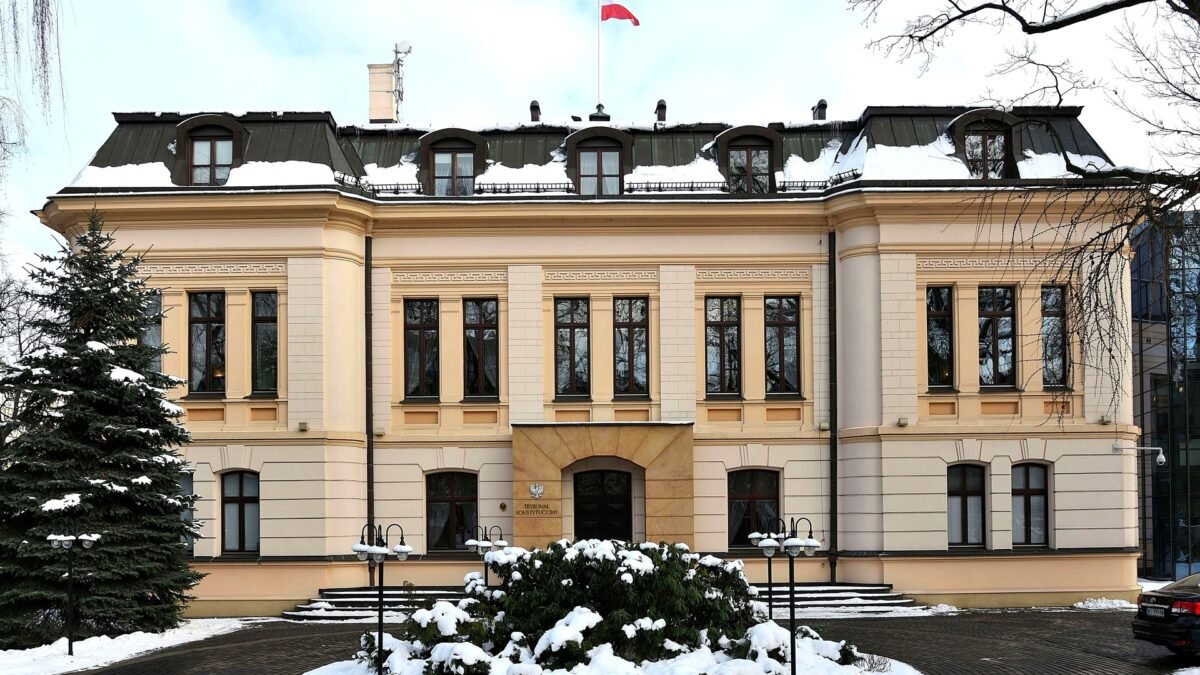
Poland’s decade-long fight over its highest court erupted into open confrontation on Friday night, when a judge suspended the president of the Constitutional Tribunal, riot police ringed the court’s building in central Warsaw, and the country’s president turned his plane around in mid-air to rush back to the capital. By Saturday evening, two rival groups were claiming to lead the same court, the prime minister was defending the intervention as the restoration of the rule of law on national television, and the European Commission was publicly backing parliament’s right to appoint the court’s judges.
The crisis began on Friday 30 October, when Judge Anna Korwin-Piotrowska, the Tribunal’s longest-serving judge, announced that she had suspended the court’s president, Bogdan Święczkowski, and his deputy, Bartłomiej Sochański, for one month and had assumed direction of the institution herself, according to Reuters. Korwin-Piotrowska was elected to the Tribunal by the current Sejm, Poland’s lower house of parliament, in March 2026, but President Karol Nawrocki has refused to swear her in. She accused Święczkowski of blocking judges elected by the current parliamentary majority from taking up their posts and of irregularities in the way cases were assigned, according to Notes from Poland, a Warsaw-based English-language outlet.
Within hours, Justice Minister and Prosecutor General Waldemar Żurek filed five motions, running to 224 pages and accompanied by 50 volumes of case files, asking for the immunity of the two suspended judges to be lifted so that they could face criminal charges, according to Rzeczpospolita. Four of the motions concern Święczkowski and one concerns Sochański. The Tribunal’s own account on X rejected the move outright, declaring that Korwin-Piotrowska “is not a judge of the Constitutional Tribunal” and that everyone involved in the proceedings had committed “the crime of a coup d’état”, according to reports of the statement.
Police arrived at the court on Aleja Szucha in central Warsaw on Friday afternoon and evening. Warsaw police said they had acted on letters from the Prosecutor General and from a Tribunal judge warning of threats to judges and staff and of a risk of public disorder, according to Liga.net. Officers entered the court grounds but, police said, did not enter the building itself. Hundreds of protesters gathered outside, demanding the reinstatement of Święczkowski, and police said three people were detained after trying to climb the fence around the complex and throwing objects at officers, according to Reuters and the Associated Press.
The most dramatic turn of the night came from the air. President Nawrocki was flying to Senegal on an official visit when news of the suspension reached him. He ordered his plane to turn back to Warsaw, writing on X: “At such a moment, the president must be in Poland.” Shortly before 1 a.m. on Saturday, he arrived at the Tribunal building, where a statement read by an aide outside the court declared: “Tonight, there was a breach of public order in the Republic of Poland and a forcible takeover of a constitutional body.” According to Onet, Nawrocki later met Święczkowski and the chief of the Supreme Court, Zbigniew Kapiński, at the presidential palace, and early on Saturday his chief of staff said the president had entered the Tribunal building with Kapiński. Polish Radio reported that Święczkowski said the gate had been opened on his instructions after a protester cut a chain.
Prime Minister Donald Tusk, whose pro-European government has been trying since December 2023 to undo the judicial changes made by the previous Law and Justice (PiS) government, defended the intervention. “Restoring the rule of law is our duty,” he wrote on X, adding that after years of lawlessness the process “requires decisive action. There is no other way.” On Saturday evening he addressed the nation in a televised speech, his first major response to the crisis, describing Friday’s events as “scandalous incidents” and saying he hoped such scenes would never be repeated in Poland. “I am certain that the Constitutional Tribunal will function as it should. Also, independently of me and in line with the constitution,” he said, according to Reuters. “The task of the executive branch, and therefore mine, is to ensure its safety and working conditions, and I intend to fulfill my duty.” He added that a democratic state had to be strong and capable of enforcing justice, and that restoring calm could not mean accepting lawlessness or violence.
The European Commission said on Saturday that it was closely monitoring the crisis. “It is for the Polish authorities to ensure that the Constitutional Tribunal can function in accordance with the Polish constitution and in respect of the relevant case law of the Court of Justice of the European Union,” a Commission spokesperson told Euronews. The spokesperson added that “the appointment of eight new members of the Constitutional Tribunal lies within the constitutional power of the Sejm, Poland’s parliament.” The Commission also pointed to interim measures issued by the European Court of Human Rights on 5 May 2026, requiring the competent Polish authorities “to refrain from hindering the taking up and exercise of judicial duties by judges appointed by the Sejm in March 2026”.
The opposition’s response was furious. PiS leader Jarosław Kaczyński appeared outside the court on Friday night, calling what had happened an attack on the Constitutional Tribunal and urging Nawrocki to intervene. On Saturday, the co-chairs of the European Conservatives and Reformists (ECR) group in the European Parliament condemned the Polish government’s actions, describing them as a violation of the rule of law and backing President Nawrocki. “The Tusk government’s actions constitute a clear and grave violation of the rule of law. We condemn this attack on judicial independence and Poland’s constitutional safeguards. No government stands above the law,” ECR co-chair Nicola Procaccini said, adding that European institutions “must not avert their eyes” and that respect for national sovereignty and judicial independence must remain a matter of principle, “unaffected by political alliances”.
Concern also came from within the judiciary itself. Jacek Chlebny, president of the Supreme Administrative Court, issued a statement expressing concern about the police presence at the Tribunal and the prevention of entry by the court’s president and vice-president. And in a striking intervention quoted by Notes from Poland, law professor Marcin Matczak, a critic of Święczkowski who has called him a poor choice for the court’s presidency, wrote: “I never thought I’d end up defending him.” Matczak argued that the legal basis for the suspension was non-existent — a point that goes to the heart of the dispute, since the case against the suspension rests on a legal route that even critics of its target dispute.
A dispute more than a decade old
The confrontation at the Tribunal is the sharpest episode yet in a constitutional crisis that began in 2015 and has never been resolved. That year, the outgoing Civic Platform government and the incoming PiS government clashed over the appointment of five judges to the 15-member court. PiS, which had won an unprecedented absolute parliamentary majority, seated its own candidates in places the European Court of Human Rights later found had not been lawfully filled. The court then ruled in March 2016 that the legislation compelling it to seat the new judges was unconstitutional — a ruling the PiS government ignored, treating it as advisory. The European Union opened an investigation under Article 7 of the Treaty on European Union, the procedure for member states at risk of breaching the bloc’s values, and the European Commission referred Poland to the Court of Justice of the European Union, saying in 2017 that the executive and legislative branches had been “systematically enabled to politically interfere in the composition, powers, administration and functioning of the judicial branch”.
The dispute widened through the PiS years, with a 2017 Supreme Court crisis and a 2019 law creating a disciplinary chamber for judges that the Court of Justice ruled against. Billions of euros in EU funds were frozen under the bloc’s rule-of-law conditionality, and the crisis at one point threatened the EU’s pandemic recovery budget, which Poland and Hungary threatened to veto in 2020 over the same conditionality clause. In the view of the EU and of Poland’s current government, the Tribunal became an instrument of the ruling party during those years; in the view of PiS and its voters, it was a lawful court defending the constitution against judicial activism.
Tusk’s coalition won the October 2023 parliamentary election on a pledge to restore the rule of law, and the European Commission responded by unblocking structural funds and terminating the Article 7 procedure. But the restoration immediately ran into a structural problem that has defined Polish politics ever since: it requires the cooperation of institutions the coalition does not control — presidential oaths, presidential signatures and the Tribunal itself. The new Sejm passed a resolution confirming the illegal status of some Tribunal justices, and the government stopped publishing some of the court’s rulings, but it could not seat its own judges without the president’s cooperation. Nawrocki, elected president in 2025 as an ally of PiS, has acted to thwart those efforts since taking office, refusing to swear in three of six judges nominated by parliament earlier this year, while Święczkowski, a former deputy justice minister in the PiS administration, declined to seat judges elected by the current majority.
The deadlock worsened through 2026. The Venice Commission of the Council of Europe said in October that the president’s refusal to swear in judges should not prevent them from taking up their posts. Last month, parliament appointed Tusk ally Maciej Berek to the Tribunal, a step critics said undermined the government’s stated goal of restoring checks and balances; Berek took his oath in parliament after the president refused to receive him at the palace. According to public broadcaster TVP World, the current Sejm has now elected eight judges, but Nawrocki has accepted the oath of only three. Friday’s suspension was, in effect, the government’s answer to a deadlock that the ordinary constitutional machinery could no longer break — and the answer itself is now contested on the same legal grounds as the deadlock it was meant to end.
Two courts, one building
As of Sunday, Poland effectively has two rival claims to the leadership of its highest court. Korwin-Piotrowska says she is in charge, backed by the justice minister’s immunity motions and by the government’s claim that the Tribunal must be freed from judges who refuse to seat lawfully elected colleagues. Święczkowski says he remains the legal president, backed by the Tribunal’s own public statements, by the president of the republic and by the opposition. The Raisina Hills, an Indian news outlet covering the crisis, reported that each side now claims the authentic leadership, with rival statements and a website taken over — a circular process in which the immunity motions were delivered to the very judge who then suspended the officials they target.
The presence of police at the court has become a symbol in its own right. The government says officers were there to protect judges and staff after warnings of threats; the opposition says their deployment inside a constitutional dispute hands it the “coup” argument on a plate. The Supreme Administrative Court president’s concern about the police presence shows that the unease is not confined to one political camp. And the fact that the president of the republic entered the building in the middle of the night, in defiance of the police cordon, raises a question no Polish institution has yet answered: when the head of state and the head of government disagree about who runs the highest court, who decides?
The immediate practical question is whether the Tribunal can function at all. The court decides whether Polish laws comply with the constitution, and its rulings shape everything from electoral law to the rights of citizens. A court whose leadership is disputed, whose judges cannot agree on who may sit, and whose building is guarded by riot police cannot perform that role with authority. Every ruling it issues while the dispute lasts risks being challenged as the product of an illegitimate bench — and every ruling it fails to issue leaves a gap in the constitutional order.
There is also a European dimension that Brussels cannot avoid. The Commission’s statement on Saturday — that appointing the eight new judges lies within the Sejm’s constitutional power, and that the European Court of Human Rights has ordered Poland not to hinder them — amounts to quiet support for the government’s position. But that support sits awkwardly with the Commission’s own history: for years it sanctioned Poland’s previous government for interfering with this same court, freezing funds and opening Article 7 proceedings. If restoration is now carried out by contested suspensions and police cordons, Brussels faces the same argument from the opposite direction, made by the people it previously sanctioned. The ECR’s condemnation on Saturday made that point explicitly, and it is likely to be pressed hard in the European Parliament in the coming days.
Analysis: Why It Matters
1. The rule of law cannot be restored by contested means
The central paradox of this crisis is that both sides claim to be defending the rule of law, and both have a case that is stronger than the other side admits. Tusk’s government is right that the Tribunal was captured during the PiS years, that the European Court of Human Rights found the 2015 appointments irregular, and that a court which refuses to seat lawfully elected judges cannot be left in place indefinitely. But the method chosen on Friday — a suspension ordered by a judge whose own status is contested, immunity motions delivered to the judge who then acted on them, and riot police at the door of the highest court — is itself of doubtful legality, as even a prominent critic of the suspended president has said. A restoration carried out by legally questionable means does not restore the rule of law; it replaces one contested court with another, and it teaches every future government that the way to fix a captured institution is to seize it.
2. Poland’s presidency is now the veto point of the state
Karol Nawrocki’s election in 2025 transformed the Polish presidency from a largely ceremonial office into the single most powerful obstacle to the government’s programme. He has refused to swear in judges, he has used the veto, and on Friday night he turned a plane around in mid-air and walked into a court building past a police cordon. The image of a president physically inserting himself into a judicial dispute is extraordinary, and it shows how personal the institutional conflict has become. Poland’s constitution gives the president the power to swear in judges and to veto legislation, but it does not give him the power to decide who runs the Constitutional Tribunal. Nawrocki’s intervention was an assertion of political authority over a legal question, and it worked — at least for now — because the state had no mechanism to stop him. That is a precedent that will outlast this crisis.
3. The European Union is caught in its own trap
Brussels spent a decade building the case that Poland’s judiciary had been captured, and it spent the last three years rewarding Tusk’s government for reversing that capture. The Commission’s careful statement on Saturday — monitoring the crisis, affirming the Sejm’s power to appoint judges, citing the Strasbourg court’s interim measures — is an attempt to support the government without endorsing the method. But the trap is real: if the Commission condemns police at the court and contested suspensions now, it will be accused of applying one standard to PiS and another to Tusk; if it stays silent, it will be accused of the same thing by the other side. The ECR has already made the accusation. The credibility of the EU’s rule-of-law machinery, which depends on being seen as legal rather than political, is on the line in Warsaw this week.
4. A paralysed court is a constitutional emergency in slow motion
The most dangerous consequence of this crisis may not be the scenes on Friday night but the quiet that follows them. A Constitutional Tribunal that cannot sit, or whose rulings are not recognised, leaves Poland without a functioning arbiter of its own constitution. Laws cannot be tested, electoral disputes cannot be settled authoritatively, and the rights of citizens lose their final guardian. That vacuum is not theoretical: Poland is scheduled to hold parliamentary elections next year, and a disputed election result landing before a disputed court would be a crisis of a different order. The longer the Tribunal stays paralysed, the more likely it is that some other institution — the president, the parliament, the streets — will try to fill the gap, and none of those is a substitute for a court.
5. This is a warning for every democracy with a captured court
Poland is not the only country where a government has inherited a judiciary shaped by its predecessors and discovered that the ordinary rules give it no lawful way to change it. The pattern — a captured court, a reforming government, a president who blocks reform, and a crisis when patience runs out — will be familiar in capitals from Budapest to Washington. What happened in Warsaw on Friday shows how that pattern ends when the deadlock is broken by force rather than by agreement: not with a restored court, but with two courts, a police cordon and a president who has learned that he can walk into the highest court in the land and nobody will stop him. The lesson for other democracies is that judicial reform has to be settled by law before the crisis arrives, because once the crisis arrives, law is the first casualty.
What to Watch Next
- The immunity motions: whether the Tribunal, under either claimant to its leadership, acts on Żurek’s five motions to lift the immunity of Święczkowski and Sochański, and whether criminal proceedings follow — or whether the motions simply deepen the standoff.
- Who controls the court on Monday: whether Korwin-Piotrowska is able to sit as the court’s acting head, whether Święczkowski resumes his duties, and whether the court’s staff and its website follow one claimant or the other.
- The European response: whether the European Commission moves beyond its Saturday statement, whether the European Parliament debates the crisis, and whether the ECR’s condemnation gathers support from other political groups.
- The president’s next move: whether Nawrocki uses his veto, his power over judicial oaths, or further public interventions to block the government’s course — and whether Tusk’s coalition, which holds the Sejm but not the presidency, has any lawful answer.
- Parliamentary elections next year: whether the crisis hardens into a campaign issue, with PiS presenting itself as the defender of the constitution and Tusk’s coalition presenting itself as the defender of the rule of law — and whether voters reward either side for a confrontation that has left the country’s highest court unable to function.
Sources
- Reuters via Devdiscourse — “Polish PM Tusk vows support for tribunal amid court crisis” (1 November 2026)
- Daily Guardian Europe — “EU Commission: Polish Parliament has right to appoint judges to the Constitutional Court” (1 November 2026)
- The Raisina Hills — “Poland Court Crisis: Tusk, Nawrocki and the Tribunal Fight” (31 October 2026)
- The Global Journal — “Poland Faces Deepening Political Crisis as Dispute Over Constitutional Tribunal Sparks Clashes Between Protesters and Police” (31 October 2026, citing the Associated Press)
- Brussels Reporter — “Donald Tusk emphasizes rule of law in Poland’s Tribunal crisis” (1 November 2026)

About the Author — advmannan1
Related Articles
Starved Residents Return From Russian-Occupied Oleshky Under First Humanitarian Truce of the War as Ceasefire Expires
Hundreds of starving residents have returned to Ukraine from the Russian-occupied town of Oleshky under a six-day ceasefire…
320,000 March Across France in Third Weekend of Youth-Led Protests as Unrest Spreads Across Europe
An estimated 320,000 people marched across France on Saturday in a third weekend of youth-led protests over living…

US and Russia Veto Each Other’s Western Sahara Plans as UN Mission MINURSO Loses Its Mandate
Russia vetoed a US plan to reshape the Western Sahara mission and Washington vetoed Moscow's rival text, leaving…