
Nicholls’ Unbeaten 113 Rescues New Zealand to 243 for 5 After Bumrah’s Opening Blitz in Wellington Test

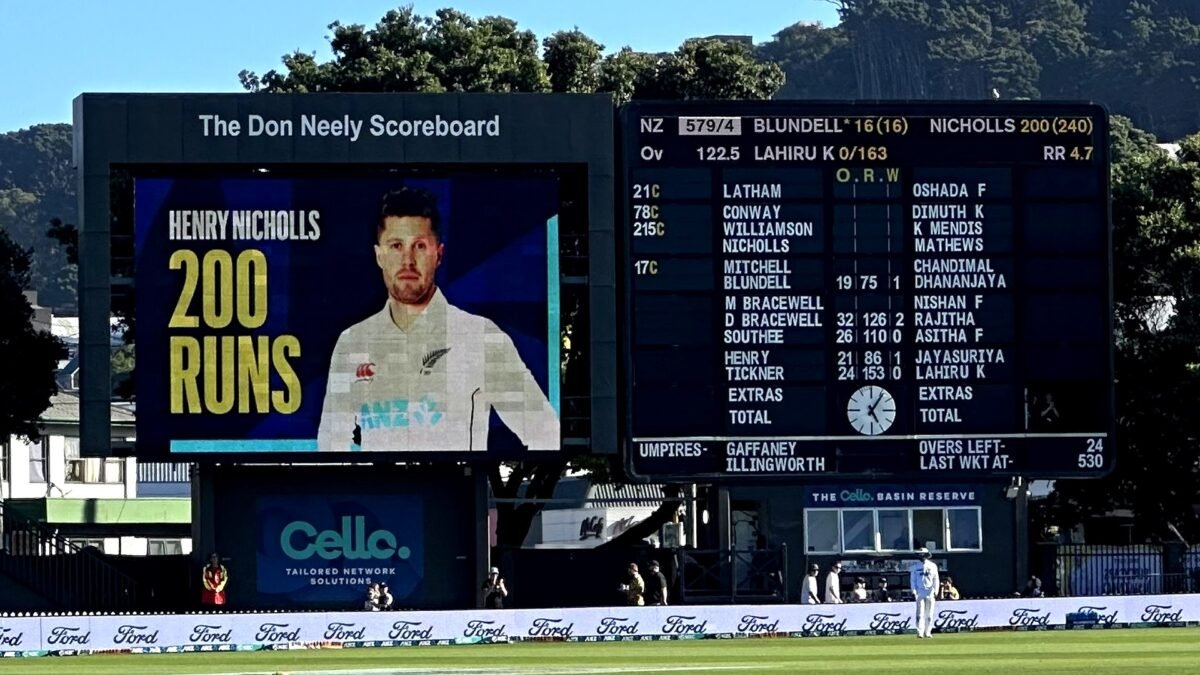
New Zealand Fight Back to 243 for 5 After Bumrah’s Opening Blitz
Henry Nicholls scored an unbeaten 113 and Glenn Phillips finished the day on 94 not out as New Zealand recovered from 70 for 5 to reach 243 for 5 at stumps on the first day of the first Test against India at the Basin Reserve in Wellington on Thursday, 19 November 2026.
The unbroken sixth-wicket partnership between Nicholls and Phillips was worth 173 runs from 327 balls, and it turned a day that had belonged to India’s fast bowlers into one that ended with the home side firmly in control. India had reduced New Zealand to 60 for 4 at lunch and 70 for 5 early in the second session, but took no further wicket in the remaining 54 overs of the day.
Jasprit Bumrah was India’s outstanding bowler, taking three wickets for 52 runs from 17 overs, including five maidens. His third wicket of the day, Tom Blundell caught at slip for five, also carried him past Javagal Srinath into tenth place on India’s all-time list of Test wicket-takers, with 237 wickets in his 53rd Test. Anshul Kamboj, on his Test debut, took one wicket for 57 from 18 overs, and Akash Deep claimed the other wicket to fall.
At the close, Nicholls had faced 221 balls and struck 14 fours, while Phillips had faced 182 balls and hit 13 fours. New Zealand’s total included 11 extras. The match is the first of a two-Test series, and the second Test begins in Christchurch on 27 November. Both teams are playing in the World Test Championship, in which New Zealand sit top of the standings and India fourth, according to Reuters.
Gill Bowls First on a Green Wellington Pitch
India captain Shubman Gill won the toss and chose to bowl first on a Basin Reserve pitch carrying around 15 millimetres of live grass. Gill said at the toss that there was more in the wicket at the start of the match than there would be later, and that he hoped his bowlers could exploit the conditions, according to Reuters. New Zealand captain Tom Latham said he would have bowled first as well.
Gill’s selection was bold. India picked four specialist fast bowlers, Bumrah, Akash Deep, Kamboj and Prasidh Krishna, with Washington Sundar as the only spinner in the side. There was no place for Mohammed Siraj, one of India’s most experienced seamers, or for Ravindra Jadeja. Gill acknowledged at the toss that leaving out Siraj had been difficult, and noted that Gurnoor Brar, who had been named player of the one-day series earlier in the tour, had also missed out.
New Zealand named a settled side. Latham captained and kept wicket in a line-up that included Devon Conway, Nicholls, Rachin Ravindra, Daryl Mitchell, Blundell and Phillips, with Nathan Smith, Kyle Jamieson, Matt Henry and Jacob Duffy forming the bowling attack. Conway, Ravindra and Blundell all returned to the batting line-up after spells on the sidelines, according to Reuters.
Play began at 11 in the morning local time, and the first hour delivered exactly what Gill had hoped for when he put New Zealand in.
Bumrah Strikes in the First Over
Bumrah needed only three balls to make the first breakthrough. Bowling to Latham in the opening over, he beat the New Zealand captain’s defence and knocked back his off stump, dismissing him for a two-ball duck. It was the worst possible start for the home side, and it brought Nicholls to the crease in the first over of the match.
Kamboj, handed his Test debut in place of the rested Siraj, struck soon afterwards, removing Conway for four, and New Zealand were 12 for 2. The two new-ball bowlers were almost unplayable in the opening hour. At one stage Bumrah had figures of two wickets for 17 runs from seven overs, with three maidens, while Kamboj had one for 11 and Akash Deep one for 15, according to the IANS news agency.
Nicholls and Ravindra tried to steady the innings, taking the score to 50 in the 19th over, but the pressure never eased. Akash Deep removed Ravindra for 15, caught behind by Rishabh Pant, and shortly before lunch Bumrah struck again, dismissing Mitchell for one, caught by Yashasvi Jaiswal at forward short leg. New Zealand went to lunch at 60 for 4 after 23 overs, with Nicholls unbeaten on 29 and Blundell on five.
The morning had belonged entirely to India. The ball had moved throughout, the fielders had held their catches, and New Zealand’s top order had no answer to the discipline of the attack. At that stage, a first-innings total below 150 looked entirely possible.
Blundell Falls, Then the Fightback Begins
The pattern continued briefly after lunch. Bumrah returned to claim his third wicket, bowling a short-of-length delivery that Blundell edged to Gill at first slip for five. New Zealand were 70 for 5 in the 29th over, and India had taken five wickets for 70 runs. The day looked lost for the home side.
It was at that point that the match changed. Phillips joined Nicholls, and the two men set about rebuilding with a mixture of discipline and controlled aggression that India never managed to break. Nicholls, who had walked in during the first over, simply refused to give his wicket away. Phillips, the more attacking of the pair, punished anything loose and kept the scoreboard moving.
By tea, New Zealand had reached 140 for 5 from 49 overs. Nicholls was unbeaten on 66 from 135 balls and Phillips on 42 from 66, and the pair had added 70 runs without loss in the session. Bumrah’s figures at the interval were three for 31, Kamboj had one for 39 and Akash Deep one for 22, according to IANS.
The second session also contained the day’s most controversial moment. In the 31st over, Bumrah beat Phillips with a delivery that jagged back and struck him flush on the pads. India were convinced the ball would have hit the stumps, and Gill sent the decision upstairs. Third umpire Paul Reiffel took his time over the replays before deciding that the on-field not-out decision should stand. Gill was seen in an animated conversation with on-field umpire Richard Illingworth afterwards. The reprieve came with Phillips on only a handful of runs, and by stumps it looked like one of the most expensive moments of the day.
Nicholls Reaches His Twelfth Test Hundred
After tea, the partnership continued to grow. Phillips reached his half-century from 73 balls, driving Bumrah for four in the 51st over, and Nicholls moved steadily towards three figures. The left-hander reached his century from 188 balls in the 70th over, driving Prasidh Krishna through the covers, and celebrated with a hug from Phillips before raising his bat to the Wellington crowd.
It was Nicholls’ twelfth Test hundred, his first against India, and his fifth at the Basin Reserve in only 15 innings at the ground. That put him alongside Kane Williamson and Martin Crowe on the list of New Zealand batters with the most Test centuries at the venue, and he reached the mark more quickly than Williamson. The hundred also took him level with Brendon McCullum and John Wright on 12 Test centuries, joint fifth on New Zealand’s all-time list.
India had one more chance. Shortly after reaching his hundred, Nicholls was dropped on 102 when Devdutt Padikkal and Pant got in each other’s way in the field, and Gill’s frustration was visible. It was the kind of miss that can decide a Test match, and India did not create another opening for the rest of the day.
By stumps, after 82 overs, New Zealand were 243 for 5. The last ten overs of the day produced only 23 runs and no wicket, and the two set batters walked off with the crowd on its feet. Nicholls had batted for 368 minutes. Phillips, on 94, was six runs short of a century of his own, and he will return on the second morning with the chance to complete it.
Bumrah Passes Srinath Into India’s Top Ten
The day’s other landmark belonged to Bumrah. His three wickets took his career tally to 237 in his 53rd Test, moving him past Srinath’s 236, according to CricTracker and the Daily Jagran. Srinath took his wickets across 67 Tests in a career that ran from 1991 to 2002, so Bumrah has passed the mark in 14 fewer matches.
Bumrah is now tenth on India’s all-time list of Test wicket-takers. Anil Kumble leads the list with 619 wickets in 132 Tests, followed by Ravichandran Ashwin with 537, Kapil Dev with 434, Harbhajan Singh with 417 and Ravindra Jadeja with 356. Bumrah’s next target is Bhagwat Chandrasekhar, who is ninth with 242 wickets. Bumrah’s career average stands at 19.76, with best figures of six for 27.
The milestone was all the more notable because Bumrah was playing his first Test of 2026. He has been carefully managed through the year, and his return to the side was one of the main talking points before the series. On the evidence of the first day in Wellington, the management has worked: he bowled 17 overs, beat the bat repeatedly, and finished with five maidens and three of the five wickets to fall.
Yet the numbers also tell the story of India’s frustration. After Bumrah’s three wickets, only Kamboj and Akash Deep struck, and Prasidh Krishna, the fourth seamer, went wicketless. The attack that had looked so threatening in the first two hours could not find a way through in the final four hours, and the bowlers will return on the second morning knowing that the first wicket of the day is now the most important ball of the match.
A Series With Recent History
This is a short series with a long shadow. New Zealand and India last met in Test cricket in November 2024, when New Zealand completed a historic 3-0 whitewash in India, winning in Bengaluru by eight wickets, in Pune by 113 runs and in Mumbai by 25 runs. It was the first time any team had swept India 3-0 in a home series of three or more Tests, and it ended India’s run of 18 consecutive home series wins stretching back to 2012.
India, meanwhile, have not won a Test match in New Zealand since March 2009. The first day in Wellington did little to suggest that drought is about to end easily. India did almost everything right in the first session and still finished the day chasing the game, because two New Zealand batters refused to be moved.
The World Test Championship context adds weight to both sides. New Zealand top the standings and India are fourth, according to Reuters, and with only two Tests in this series, every session carries points that could decide who reaches the final. A draw would suit neither side entirely, but a New Zealand win in Wellington would leave India needing to win in Christchurch simply to square the series.
For New Zealand, the day also confirmed the value of experience. Nicholls is 35 years old and has spent much of the last two years fighting for his place, yet he produced his best innings of the year on a pitch that offered the bowlers everything in the morning and his favourite ground in the afternoon. Phillips, at 28, has become one of the most important players in the side, a cricketer who can change a session with bat, ball or in the field, and his unbeaten 94 was the perfect partner’s innings.
Analysis: Why It Matters
The toss gamble nearly won the day, then nearly lost it
Gill’s decision to bowl first was the right call on the evidence of the first hour, and it was also a gamble. A pitch with 15 millimetres of grass in Wellington is a bowler’s pitch in the morning and a batter’s pitch by the afternoon, and India had to take enough wickets before the surface flattened out. They took five for 70, which should have been enough. The fact that they took none for 173 after that is the story of the day, and it raises a question about the attack’s depth. Bumrah is world-class, but when he tired, the other three seamers could not reproduce his threat. Leaving out Siraj and Jadeja was a bold selection, and it will be judged harshly if New Zealand post 400 or more.
Nicholls is the Basin Reserve’s own specialist
Five Test centuries at one ground is a rare achievement, and Nicholls now shares the Basin Reserve record with Williamson and Crowe, two of the greatest batters New Zealand has produced. What makes the feat more remarkable is that Nicholls reached it in 15 innings, faster than Williamson. He has always been a player who divides opinion, a grafter rather than a stylist, but at this ground he bats like a man who owns the place. His 113 on Thursday was not his most fluent innings, but it may have been his most important for some time, because it came after his team had lost five wickets for 70 and the series was threatening to slip away on the first morning.
Bumrah’s milestone came in a losing session
Passing Srinath to enter India’s top ten is a landmark that puts Bumrah in the company of Kumble, Ashwin, Kapil Dev and Harbhajan Singh, and doing it in his 53rd Test, 14 fewer than Srinath needed, underlines how quickly he has climbed the list. His average of 19.76 is the best of any bowler in the top ten by a wide margin. But the milestone will mean little to him if India lose this Test, and the irony of the day is that his best bowling came when the match was already drifting away. His three wickets were all top-order wickets taken in the first two sessions, and after tea he could not dislodge either set batter. Even the greatest fast bowlers need support, and on Thursday Bumrah did not get enough of it.
The DRS reprieve could decide the match
Phillips was on a handful when Bumrah struck him on the pads in the 31st over, and the third umpire’s decision to let the not-out call stand will be debated for the rest of the series. India were convinced the ball was hitting the stumps, and Gill’s reaction at the time showed how strongly the team felt. If Phillips goes on to score a century on the second morning, the cost of that decision will be measured in runs, and in the difference between a first-innings total of 250 and one of 350 or more. DRS decisions are part of the game, and India will not complain publicly, but privately they will know that the moment the match turned may have been the one they could not control.
Day two will decide the shape of the series
The first hour of the second day is now the most important passage of the match. If India break the partnership quickly, they can still restrict New Zealand to a total around 300 and keep the game in the balance. If Nicholls and Phillips bat through the morning, New Zealand will be looking at 400 or more, and India will be batting last on a wearing pitch against an attack that includes Matt Henry, Kyle Jamieson and Jacob Duffy. The two-Test series means there is no room to recover from a bad start, and the team that wins in Wellington will carry all the momentum to Christchurch. For India, the equation is simple: take early wickets on Friday morning, or spend the rest of the series chasing the game.
What to Watch Next
- Glenn Phillips resumes on 94, six runs short of his century, with the chance to complete a hundred on the second morning.
- Henry Nicholls, unbeaten on 113, will look to turn his century into a double hundred at his favourite ground.
- India need an early breakthrough on day two to expose New Zealand’s lower order and keep the first-innings total below 350.
- Jasprit Bumrah needs five more wickets in the match to pass Bhagwat Chandrasekhar’s 242 and move to ninth on India’s all-time Test wicket-takers list.
- The second and final Test of the series begins in Christchurch on 27 November, leaving the loser in Wellington with little time to regroup.
- The World Test Championship standings will shift after this match, with table-topping New Zealand defending their lead against fourth-placed India.
- India’s selection will come under scrutiny if New Zealand post a big total, with the omissions of Mohammed Siraj and Ravindra Jadeja certain to be revisited.
Sources
- ESPNcricinfo — New Zealand vs India, 1st Test live scorecard, Basin Reserve, Wellington
- Reuters — India win toss and bowl in first Test against New Zealand
- SportsLine — Nicholls 113 and Phillips 94 lift New Zealand to 243/5 at stumps on day one
- IANS via Hi India — Bumrah strikes twice as India reduce New Zealand to 60/4 at lunch on day one
- Daily Jagran — Jasprit Bumrah goes past Javagal Srinath in India’s Test records
- CricTracker — Bumrah goes past Srinath into India’s all-time top 10 Test wicket-takers

About the Author — Abdul Mannan
Related Articles
Pat Cummins Faces Captaincy Crisis as Bancroft’s Sandpapergate Tell-All Reopens Cricket’s Darkest Scandal
Cameron Bancroft's 4,000-word statement says the whole Australian team knew about the sandpaper plot — and the cricket…
Ben Duckett’s 133 Seals England’s First ODI Series Win in Australia in Eight Years as Hosts Collapse Again in Hobart
Ben Duckett struck 133 and Sonny Baker took four wickets as England beat Australia by 97 runs in…

India Beat Pakistan 2-1 to Win Record 10th SAFF Title as Both Teams Share Guards of Honour in Dhaka
India came from behind to beat Pakistan 2-1 in the SAFF Championship final in Dhaka, then both teams…