
Pakistan Military ‘Cautiously Optimistic’ on Iran–US Mediation as Army Chief’s Tehran Trips Signal Progress

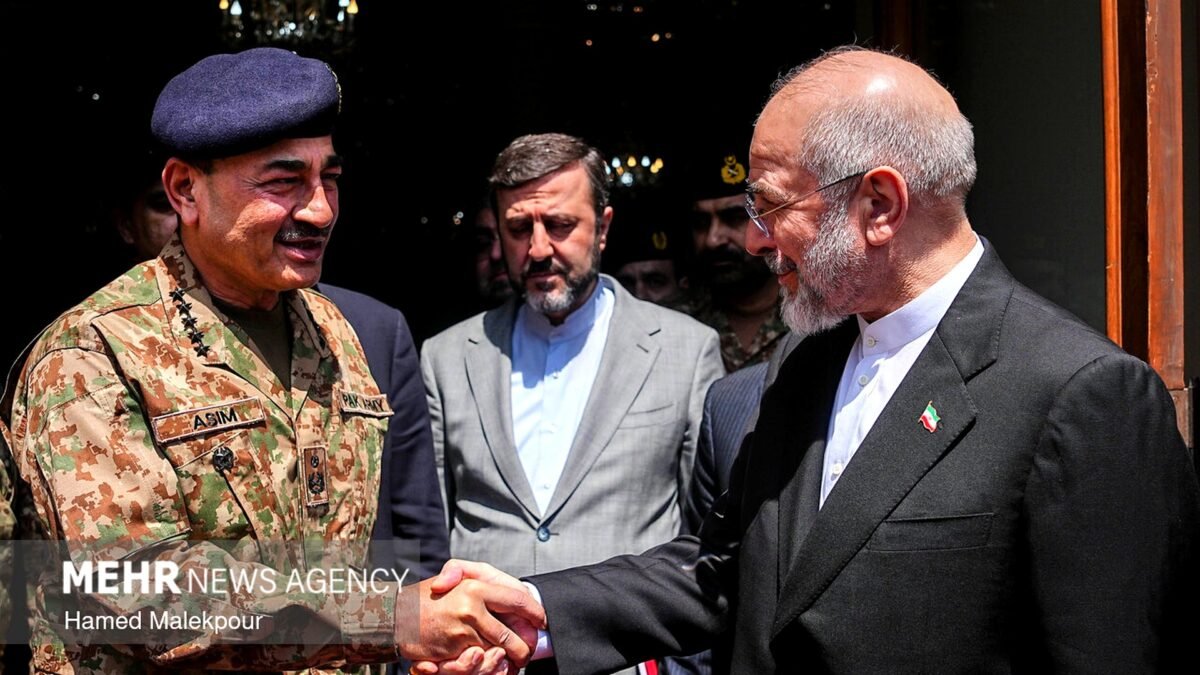
Pakistan’s military has said it is “cautiously optimistic” about its mediation between Iran and the United States, offering the clearest public signal yet that behind-the-scenes diplomacy aimed at ending the eight-month-old war may be making headway.
Lieutenant General Ahmed Sharif Chaudhry, the director general of Inter-Services Public Relations (ISPR), gave the assessment in an interview with Reuters on Friday, his first since a high-level Pakistani delegation visited Tehran this week. Asked whether the trips by Pakistan’s army chief to the Iranian capital were a positive sign, he answered plainly, according to Reuters: “Why would the Field Marshal be going twice if it is not for some positivity? So yes, of course.”
“The word that we would use is always cautiously optimistic,” he added.
The remarks matter because they come from the institution that has taken the leading role in the mediation effort. Field Marshal Asim Munir, Pakistan’s Chief of Defence Forces and Chief of Army Staff, has travelled to Tehran twice this month, most recently on Monday alongside Saudi Defence Minister Prince Khalid bin Salman and Turkish intelligence chief Ibrahim Kalin. Reuters described Munir as Pakistan’s chief mediator in its efforts to de-escalate the war, which began on 28 February 2026 when the United States and Israel launched a military offensive against Iran.
Chaudhry declined to say what was discussed in Tehran or whether the United States had backed the trip, and he warned that the effort still faced opposition. There were still “powerful spoilers and detractors” who believed conflict served them, he said, without naming them.
The interview landed on the same day that Qatari mediators returned to Tehran in a separate bid to negotiate a revival of the ceasefire that collapsed months after it was first agreed in June, according to Al Jazeera. The convergence of the two mediation tracks — one led by Pakistan with Saudi and Turkish backing, the other by Qatar — has raised expectations in the region that a diplomatic opening, however narrow, may be forming even as military preparations continue.
The Tehran trips
Munir’s two visits to Tehran in a single month are unusual by any measure. The first came early in October; the second, on Monday 26 October, brought together the senior security figures of three of the region’s most consequential states. Prince Khalid bin Salman, Saudi Arabia’s defence minister, and Ibrahim Kalin, the head of Turkish intelligence, travelled with him, turning what might have been a bilateral Pakistani mission into a display of collective regional diplomacy.
After Monday’s talks, Mohsen Rezaei, the secretary of Iran’s Supreme National Security Council, said regional security should be ensured by regional countries without foreign intervention, a formulation that has become a recurring theme in Tehran’s public statements about the mediation. The wording is significant: it suggests that Iran, at least in public, is willing to frame the talks as a regional process rather than a negotiation conducted under American pressure.
Chaudhry’s decision to speak publicly about the effort at all is itself a choice. Military spokesmen in Pakistan rarely discuss live diplomatic initiatives in detail, and the ISPR chief’s first interview since the Tehran delegation returned was plainly intended to be heard in Washington, Tehran, Riyadh and Ankara alike. His message was calibrated: progress exists, but it is fragile, and those who benefit from continued fighting have not gone away.
What the two sides actually discussed remains undisclosed. Chaudhry would not confirm whether the United States had endorsed the mission, and Reuters reported that he declined to describe the substance of the talks. That silence is consistent with the pattern of the mediation so far, in which the public record has consisted of hints and atmospherics rather than concrete proposals. Earlier reporting has described an exchange of messages and proposals through intermediaries: a letter from US Vice President JD Vance to Rezaei, delivered through Qatar, which Tehran has not answered; a seven-day plan put forward by Iranian Foreign Minister Abbas Araghchi, also through Qatari channels; and seven conditions set out by Iranian parliament speaker Mohammad Baqir Qalibaf, who hosted Munir in Tehran in April.
The United States, for its part, has kept both tracks open. US envoy Tom Barrack said this week that Washington was close to a deal with Iran as regional powers mediate, citing the efforts of Qatar, Pakistan, Saudi Arabia and Türkiye. At the same time, the Associated Press has reported that American officials have warned regional states to prepare for possible renewed strikes after the 3 November midterm elections, an operation that could last several days, and that President Donald Trump has not yet decided whether to order it. Speaking to reporters on Friday, Trump said of the war: “It’s going to get wrapped up soon.”
The Mecca pact and an open door
Chaudhry also used the interview to discuss the Mecca Joint Defence Agreement, the pact signed on 7 August by Pakistan, Saudi Arabia and Türkiye under which an attack on any signatory is treated as an attack on all. Pakistan and Saudi Arabia completed ratification of the agreement on Friday, the Foreign Office said, leaving Türkiye as the only signatory still working through its approval process.
The agreement has taken on added significance as the war has redrawn regional alliances and raised fears of a broader Middle East conflict, Reuters noted. Asked whether Iran could join it, Chaudhry said the wording of the pact did not bar new members. “Anyone who has a shared vision of collective deterrence and regional peace, why not? Everyone is most welcome,” he said, adding that it was for the political leadership of the three principal parties to decide.
The remark is striking for what it implies. Extending a collective defence pact to Iran — the very state the pact’s members have spent eight months trying to shield themselves from, and in Saudi Arabia’s case, the state whose allied Houthi movement has fired missiles and drones at the kingdom — would transform the agreement from a defensive arrangement against Tehran into a regional security architecture that includes it. Whether that is a genuine invitation, a negotiating signal, or simply a refusal to close a door in public, it reframes the pact as something more flexible than its original signing suggested.
Chaudhry was asked whether more Pakistani troops were being sent to Saudi Arabia under the agreement. He said that would depend on the situation and the decision of both countries’ political leadership. He also said Pakistan was committed to defending Saudi Arabia and the holy sites of Mecca and Medina, while adding: “We are not part of the Yemeni conflict, which is an intra-Yemen conflict.”
The distinction matters. Fighting between Saudi Arabia and Yemen’s Iran-aligned Houthi movement has been reignited by the Iran conflict, stoking fears of a wider war, and Saudi forces shot down a Houthi drone near Mecca on Friday, a claim the Houthis denied. By separating the defence of Saudi territory and the holy sites from the Yemeni war, Chaudhry drew a line that preserves Pakistan’s longstanding reluctance to join the Yemen campaign while reaffirming the core commitment at the heart of the Mecca pact.
Spoilers and detractors
The warning about “powerful spoilers and detractors” was the interview’s most pointed passage, and also its most opaque. Chaudhry did not say who he meant, and the phrase could cover a wide range of actors: hardliners in Tehran who oppose any accommodation with Washington; voices in Israel who have argued for continued military pressure; Gulf actors who benefit from high oil prices; or political forces inside the United States who regard a negotiated settlement as a concession.
The warning is not abstract. The mediation effort has already survived one collapse: the June ceasefire, which held for a time before unravelling, and which Qatari mediators are now trying to revive. Each round of diplomacy in this war has been accompanied by military escalation somewhere in the region — in the Strait of Hormuz, where limpet-mine attacks on tankers have continued through October; in the Red Sea and the Gulf, where Houthi attacks on Saudi targets have intensified; and in the diplomatic arena, where the language of both sides has hardened even as their envoys have kept talking.
The shipping war is itself a form of pressure on the negotiations. According to Reuters, 28 attacks on commercial vessels were recorded in the Strait of Hormuz in October alone, and 113 since the war began, and oil prices have climbed through the month, with Brent crude above $116 a barrel and US crude above $102. The United States military says it has cleared the main shipping lanes of mines, but Iranian media have continued to claim that the southern route through the strait is mined and dangerous. The cost of the war to the United States alone had reached $47.1 billion by 16 October, according to figures the US Central Command provided to Congress, with 21 American service members killed and 865 wounded since February.
The mediation track
Pakistan’s role as mediator has grown steadily since the spring. In April, Islamabad hosted talks between a US delegation led by Vice President Vance and an Iranian delegation led by Qalibaf, and the Pakistani capital has since become one of the regular waystations of the diplomacy. Munir’s standing in Washington — he has met President Trump at the White House — and Pakistan’s channels to Tehran have made him one of the few figures acceptable to both sides as a go-between.
That acceptability rests on a delicate balance. Pakistan shares a long border with Iran and a large Shia minority at home; it is also a close partner of Saudi Arabia, a recipient of Saudi financial support, and now a formal defence ally of Riyadh and Ankara. It has historically tried to avoid choosing between Tehran and Riyadh, and the mediation effort is the most ambitious expression of that balancing act yet attempted. The Mecca pact complicates it: Pakistan is now formally committed to treating an attack on Saudi Arabia as an attack on itself, even as it mediates between Saudi Arabia’s adversary and the United States.
The other mediators face their own constraints. Qatar, which has hosted or channelled several rounds of indirect talks, has leverage with both Tehran and Washington but limited ability to enforce any agreement. Türkiye has its own channels to Iran and to the United States, and its intelligence chief’s presence in Tehran on Monday signalled Ankara’s direct involvement in the effort. Saudi Arabia, which has been drawn deeper into the conflict by Houthi attacks and by the threat to its oil infrastructure, has the most immediate interest in a settlement — and the most to lose if one fails.
The home front
Chaudhry was also asked about the situation at home, where the federal government suspended the provincial government in Khyber Pakhtunkhwa, led by the Pakistan Tehreek-e-Insaf (PTI) of jailed former prime minister Imran Khan, on 11 October and detained Chief Minister Sohail Afridi. The PTI has rejected the move, which was imposed under Articles 232 and 234 of the Constitution, and has challenged it in the Peshawar High Court, arguing that the constitutional conditions for an emergency were not met.
Asked whether there would now be larger military-led campaigns in the province, Chaudhry said that was not how the army conducted counter-terrorism. “Our counter-terrorism operations are based on what we call IBOs, intelligence-based operations,” he said. “The tempo of the freedom of action of (those) IBOs will further increase.”
The exchange underlined how closely Pakistan’s domestic politics and its foreign policy are now intertwined. Khyber Pakhtunkhwa was the only province controlled by Khan’s party: PTI-backed independents won the most directly elected seats in the February 2024 general election but fell short of a majority. Khan has been in jail since 2023, and his supporters see the military behind his imprisonment and the dismantlement of the PTI. The army denies involvement in politics. The province also borders Afghanistan, where cross-border violence has flared repeatedly in recent weeks, including clashes around Angoor Adda in South Waziristan in which Pakistani forces destroyed several Afghan Taliban border posts.
The domestic confrontation is not a sideshow to the mediation. A government that is simultaneously suspending an elected provincial administration, managing a confrontation with the Afghan Taliban, and mediating a war between Iran and the United States is operating on several fronts at once, and the strain shows in the care with which its military spokesman chose his words on each of them.
Analysis: Why It Matters
Why Islamabad is talking now
Governments do not usually advertise a mediation while it is still fragile unless they want the fact of the mediation itself to do work. Chaudhry’s interview served several audiences at once. To Washington, it said that Pakistan’s channel to Tehran is active and producing movement, and that the United States has a diplomatic option that does not require a new round of strikes after the midterms. To Tehran, it said that the effort is being taken seriously at the highest level in Rawalpindi, and that the Field Marshal’s repeated travel is itself evidence of good faith. To Riyadh and Ankara, it said that the Mecca pact’s members are acting together, not separately. And to the spoilers he warned about, it said that their opposition has been noticed.
The choice of the word “cautiously” is doing as much work as the word “optimistic”. It gives Pakistan room to step back if the talks collapse without having overpromised, and it signals to Tehran that Islamabad is not going to declare success before there is something concrete to declare. In a negotiation where both sides have repeatedly used public statements as leverage, calibrated ambiguity is a tool, not a failure of candour.
The pact as leverage
The most consequential part of the interview may prove to be the passage about the Mecca pact’s open membership. A collective defence agreement that can, in principle, admit the state it was partly designed to deter is a very different instrument from a closed alliance. If Iran were ever to join, the pact would become a regional security arrangement in the full sense — a framework in which the Gulf’s rival powers guarantee each other’s security rather than organising against one another.
That is a distant prospect, and Chaudhry was careful to say the decision belongs to the political leadership of the three current members. But even as a hypothetical, it changes the bargaining geometry. It gives Tehran a reason to see the pact as a potential destination rather than a threat, and it gives the pact’s members a positive inducement to offer Iran in exchange for concessions on its nuclear programme and its regional activities. The history of such arrangements suggests that the invitation matters as much as the answer: it reframes the question from whether Iran can be contained to whether it can be included.
The spoiler warning, and who benefits from failure
Every negotiation has opponents, but this one has unusually powerful ones, and Chaudhry’s refusal to name them is itself informative. Naming a spoiler is an accusation; warning about spoilers in general is a signal to all of them at once that their efforts are visible and will be attributed.
The beneficiaries of continued war are not hard to identify. Oil producers and traders profit from the risk premium that has pushed Brent above $116. Armed groups that thrive on regional instability gain relevance and recruits. Political factions in several capitals have built their standing on confrontation and would lose influence in a settlement. And outside the region, there are actors who regard a durable US-Iran understanding as a threat to their own security arrangements. The mediation’s survival depends on whether the governments that want a deal can impose costs on those who do not — and the first step is making clear that the sabotage is expected.
The limits of optimism
For all the positive signals, the structural obstacles to a deal have not moved. The United States has warned its regional partners to prepare for possible renewed strikes after 3 November, and the USS Theodore Roosevelt carrier strike group and the Makin Island amphibious ready group are heading to the Middle East, arriving by the end of November. Iran has not answered the Vance letter, and its parliament speaker’s seven conditions and its foreign minister’s seven-day plan have not produced a documented convergence. The June ceasefire collapsed once already, and the tanker war in the Strait of Hormuz continues.
“Cautiously optimistic” is therefore best read as a description of the process, not the outcome. It means the channels are open, the parties are talking, and the trips to Tehran are producing something worth a second visit. It does not mean the gaps have closed. The history of this war suggests that the distance between a functioning mediation and a signed agreement is where most efforts die, and that the final stretch is usually the most dangerous, because it is when the spoilers have the most to lose.
Pakistan’s balancing act
For Pakistan, the stakes of the mediation go beyond the war itself. Success would establish Islamabad as an indispensable regional broker — a state that can talk to Tehran, Riyadh, Ankara and Washington at the same time, and be trusted by all of them. Failure, particularly a failure followed by a new round of American strikes, would leave Pakistan exposed on every side: a formal defence ally of Saudi Arabia, a neighbour of Iran, and a partner of the United States, with no settlement to show for its efforts.
The balancing act is already visible in the fine distinctions Chaudhry drew: committed to defending Saudi Arabia and the holy sites, but not part of the Yemeni conflict; open to Iran joining the pact, but only if the three current members’ political leaders agree; optimistic about the mediation, but only cautiously. Each of those formulations is a tightrope, and the interview as a whole reads as an attempt to walk all of them at once. Whether Pakistan can keep its balance if the war escalates again is the question that will decide whether this mediation is remembered as a turning point or as a footnote.
What to Watch Next
- The 3 November marker: The Associated Press has reported that US officials warned regional states to prepare for possible renewed strikes after the midterm elections. Whether that deadline passes quietly or is followed by military action will be the first real test of whether the mediation has changed Washington’s calculations.
- Qatar’s parallel track: Qatari mediators returned to Tehran on Friday to pursue a revival of the June ceasefire. Any convergence between the Qatari and Pakistani tracks — or any sign that they are working at cross-purposes — will show whether the region’s diplomacy is coordinated or competitive.
- An answer from Tehran: The Vance letter delivered through Qatar remains unanswered, and the fate of Araghchi’s seven-day plan and Qalibaf’s seven conditions is unclear. A formal Iranian response, in either direction, would be the clearest indicator of whether the optimism is reciprocated.
- The Mecca pact’s next step: With Pakistan and Saudi Arabia having completed ratification, attention turns to Türkiye’s approval process and to whether the question of new members — and specifically Iran — is raised formally by any of the three governments.
- The Strait of Hormuz: Limpet-mine attacks on tankers continued through October, and oil prices have risen on the disruption. Whether the shipping war pauses while talks proceed, or continues as a form of pressure, will reveal how seriously the parties take the diplomacy.
Sources
- Reuters — “Pakistan military ‘cautiously optimistic’ on Iran-US mediation” (exclusive interview with Lt Gen Ahmed Sharif Chaudhry, 30 October 2026)
- Clash Report — “Pakistan ‘Cautiously Optimistic’ on US-Iran Talks, Warns of Spoilers” (30 October 2026)
- Dispatch Times — “US-Iran mediation offers guarded hope, Pakistan army says” (30 October 2026)
- Hatha Alyoum — “Pakistan ‘cautiously optimistic’ about US-Iran talks, says Mecca pact open to new members” (30 October 2026)
- Devdiscourse — “Exclusive: Pakistan military ‘cautiously optimistic’ on Iran-US mediation” (Reuters syndication, 30 October 2026)

About the Author — Abdul Mannan
Related Articles
Pakistan’s 30-Member Electoral Reforms Committee Takes Shape as Opposition Weighs Joining and Fazl Pushes a New Charter of Democracy
Islamabad says a 30-member parliamentary committee on electoral reforms is formed; the opposition signals it may join after…
Pakistan Anti-Terrorism Court Sentences Rights Lawyers Imaan Mazari and Hadi Ali Chattha to 10 Years Each
An anti-terrorism court has sentenced human rights lawyers Imaan Mazari and Hadi Ali Chattha to 10 years each…
One Killed and Five Injured as Cross-Border Firing Hits Angoor Adda Market and Homes, Pakistan Says
One civilian was killed and five people were injured when firing struck houses and a market at Angoor…